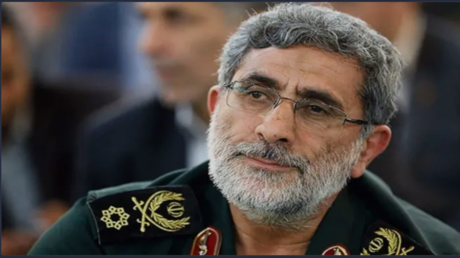
In a provocative statement, General Ismail Qaani, commander of the Quds Force of the Islamic Revolutionary Guard Corps, asserted that "the fate of all US terrorist forces is to flee from the region." These remarks come at a time when relations between Iran and the United States are increasingly strained, raising concerns in political and military circles.
Qaani's comments come amid rising tensions in the Middle East, where the United States continues to bolster its military presence while Iran seeks to enhance its influence by supporting its allies in Iraq, Syria, and Lebanon.
Details of the Statement
The general made these statements during an official event, noting that US forces have failed to achieve their objectives in the region and will ultimately be forced to withdraw. These remarks reflect Iran's strategy in countering US pressures and emphasize its steadfast position in defending its regional interests.
Qaani also added that Iran will continue to support its allies in the region, indicating that any US movements will be met with a strong reaction from Iranian forces and their allies. These statements come at a sensitive time, as fears of a potential military escalation between the two sides are growing.
Background & Context
Historically, Iranian-American relations have been marked by ongoing tensions since the Islamic Revolution in 1979. Since then, the United States has imposed severe economic sanctions on Iran, exacerbating the country's economic and political situation. In recent years, tensions have notably increased, especially following the US withdrawal from the nuclear agreement in 2018.
Iran seeks to bolster its influence in the region by supporting armed groups in Iraq, Syria, and Lebanon, which the United States considers a threat to its national security. This ongoing conflict reflects the geopolitical rivalry between the two powers in the Middle East.
Impact & Consequences
Qaani's statements could lead to an escalation of tensions between Iran and the United States, increasing the likelihood of military confrontations. If these tensions persist, regional stability may be significantly affected, negatively impacting neighboring countries.
Additionally, these remarks may influence the relationships between Iran and its allies, as each party seeks to strengthen its position in the face of external pressures. The region may witness further military and political maneuvers in the near future.
Regional Significance
Qaani's statements serve as a warning to Arab countries cooperating with the United States, as any escalation in tensions could destabilize the region. Arab nations, already grappling with internal and external conflicts, may find themselves in a difficult position if conditions worsen.
Moreover, any military escalation could impact oil prices and financial markets, increasing economic pressures on Arab countries. Therefore, monitoring developments in Iranian-American relations is of utmost importance.
In light of these statements, the question remains about how the situation in the region will evolve. Will diplomacy succeed in easing tensions, or is military escalation the only available option?