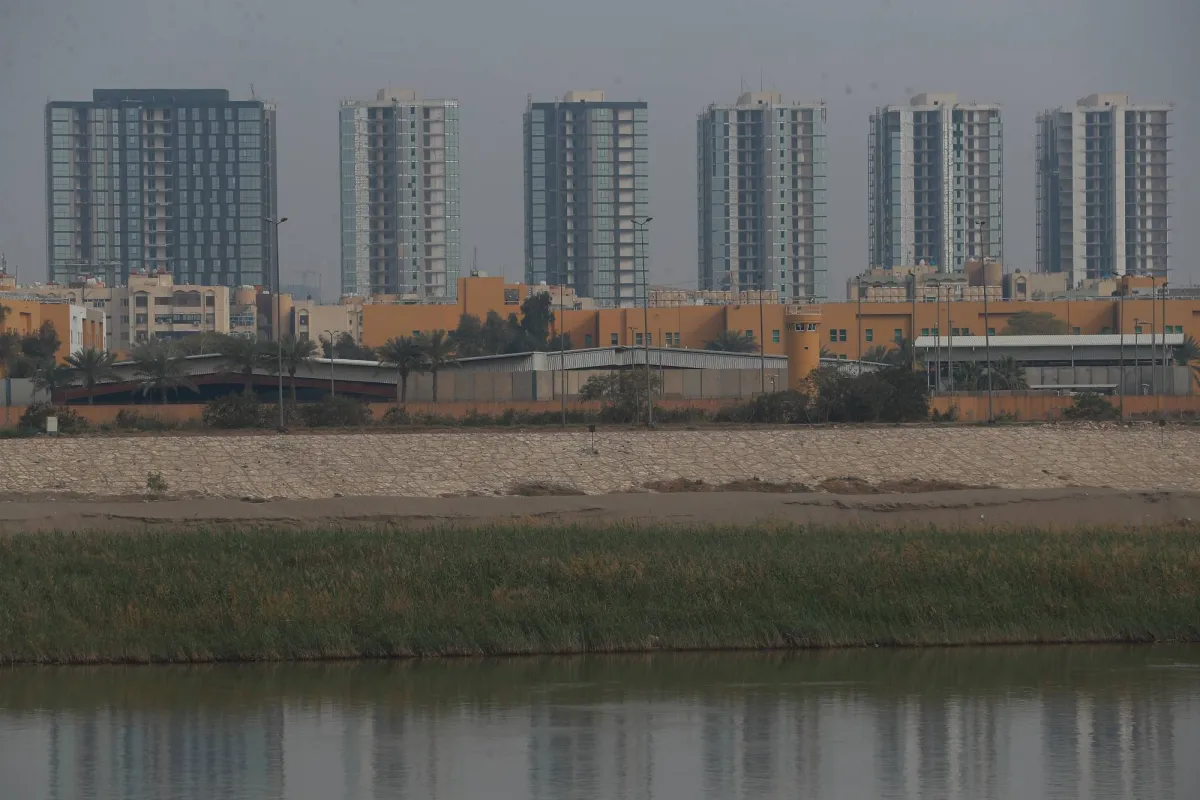
On Saturday evening, Iraqi air defenses intercepted two drones that were heading towards the US Embassy in Baghdad, according to two security officials speaking to Agence France-Presse. This attack is the first of its kind on this diplomatic mission in ten days, reflecting the persistent security tensions in Iraq.
A source from the Iraqi Joint Operations Command explained that "two drones attempted to attack the US Embassy but were shot down outside the Green Zone," which is the fortified area that houses diplomatic missions and international institutions. A second security official confirmed the thwarting of the attack.
Details of the Incident
The last attack on the US Embassy in Baghdad occurred on March 18, when the Iranian-backed Iraqi group, Kata'ib Hezbollah, announced a five-day halt to targeting the embassy under certain conditions. This deadline was extended twice, with the latest extension occurring on Friday evening.
The conditions set by the "brigades" included halting Israeli attacks on residents of the southern suburbs of Beirut and committing to not bomb residential areas in Baghdad and other provinces. This tension arises at a time when the facilities of the Popular Mobilization Forces and Iranian-backed Iraqi factions are being subjected to strikes attributed to the United States and Israel.
Background & Context
In a related context, the Popular Mobilization Forces announced the death of three of their members in an attack on their headquarters in Kirkuk, northern Iraq, while two members of the police in Mosul were killed in strikes on their location. These attacks have been attributed to the United States and Israel, complicating the security landscape in Iraq.
The Popular Mobilization Forces were established in 2014 to fight the ISIS organization, and since then, they have become part of the Iraqi military structure. The organization issued a statement confirming that their command center for northern operations and eastern Dijla was subjected to a Zionist-American attack through three airstrikes, resulting in the martyrdom of three fighters and injuries to four others.
Impact & Consequences
These developments come at a sensitive time, as Iraq and the United States announced an intensification of security cooperation to prevent attacks on Iraqi security forces and American interests. A high-level joint coordination committee has been formed between the two sides to enhance security cooperation.
At the same time, several Arab countries have called on Iraq to take measures to stop attacks launched by armed factions towards their territories. Iraq has announced its rejection of any aggression that affects these countries from its territory, reflecting the increasing regional tensions.
Regional Significance
These events are seen as indicators of rising tensions in the region, where regional and international interests are increasingly overlapping. The repeated attacks on the US Embassy and the Popular Mobilization Forces indicate that Iraq remains a battleground for conflict among regional powers.
In this context, French President Emmanuel Macron has called for all possible efforts to prevent dragging Iraq into the ongoing escalation in the Middle East, emphasizing the importance of Iraq's sovereignty and stability.
In conclusion, these events demonstrate that Iraq remains at the heart of regional tensions, necessitating an effective diplomatic and security response from all concerned parties.