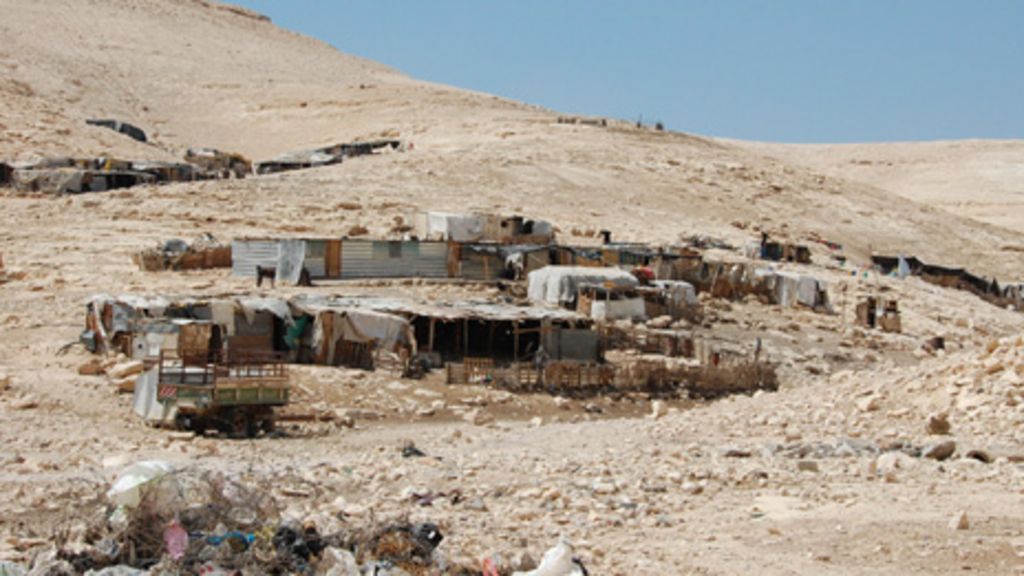
The Palestinian Governorate of Jerusalem has issued a warning regarding an Israeli plan that seeks to eliminate the presence of Palestinian Bedouin communities in the governorate, relocating them from their settlements to a newly established neighborhood and replacing them with Israeli settlers.
According to the governorate's announcement, a plan known as "Shami Neighborhood" aims to reshape the geographical and demographic reality east of Jerusalem. This plan signifies the end of Bedouin communities and their relocation from the vast desert to a new neighborhood within a small enclave, facilitating the establishment of colonial expansion projects on their ruins.
Details of the Plan
The governorate indicated that the Israeli occupation authorities submitted the plan last week to the subcommittee for planning and licensing under the Higher Planning Council of the Israeli Civil Administration, which is affiliated with the army, to establish it on approximately 170 dunams (where one dunam equals one thousand square meters) within the lands of the town of "Abu Dis" east of the city.
If implemented, the plan would lead to the end of the existence of communities such as Khan al-Ahmar, Abu Nuwar, Arab al-Jahalin, Wadi Jamil, Jabal Baba, Wadi Sinisil, and Bir al-Maskoub. Their residents would be forcibly relocated to the planned area and placed in modern housing that does not suit the Bedouin lifestyle and its needs, including livestock breeding, mobility, and movement.
Background & Context
The Jerusalem Governorate clarified that the plan aims to convert the land from its pastoral and agricultural uses to an urban residential neighborhood classified as "B," according to the Oslo II Agreement of 1994. This means that it will be subject to Palestinian civil control and Israeli security control.
For the Bedouins, 79 dunams will be allocated for residential construction, imposing a population density of up to 12 housing units per dunam with a height of 6 floors, along with more than 35 dunams designated for road networks.
Impact & Consequences
According to the governorate, the plan will represent a direct extension of the forced displacement policies that began in 1997 when groups of Jahalin Bedouins were moved to the outskirts of Al-Eizariya for the benefit of settlement expansion. The governorate emphasized that the occupation is today reproducing the same policies.
According to data released by the United Nations Office for the Coordination of Humanitarian Affairs (OCHA) in 2017, there are 26 Bedouin communities spread across the Jerusalem governorate, inhabited by 4,856 Bedouins at that time.
Regional Significance
The Bedouins of Jerusalem belong to the "Jahalin" clan, known in Palestine as "Arab al-Jahalin." As a result of their displacement during the Nakba in 1948, they sought refuge in the West Bank, coming from the Tel Arad area in the Negev, which extends over an area of approximately 50 kilometers northeast of Beersheba (southern Palestine) and is located 30 kilometers south of Hebron.
Since the onset of the genocide against Gaza on October 7, 2023, the assaults by the occupation and settlers have led to total and partial migration of 79 Palestinian Bedouin communities in the West Bank, home to 814 families with a population exceeding 4,700 individuals, according to data from the Palestinian Wall and Settlement Resistance Commission.
According to the same source, the number of settlements and outposts in the West Bank exceeds 542, inhabited by more than 780,000 settlers.