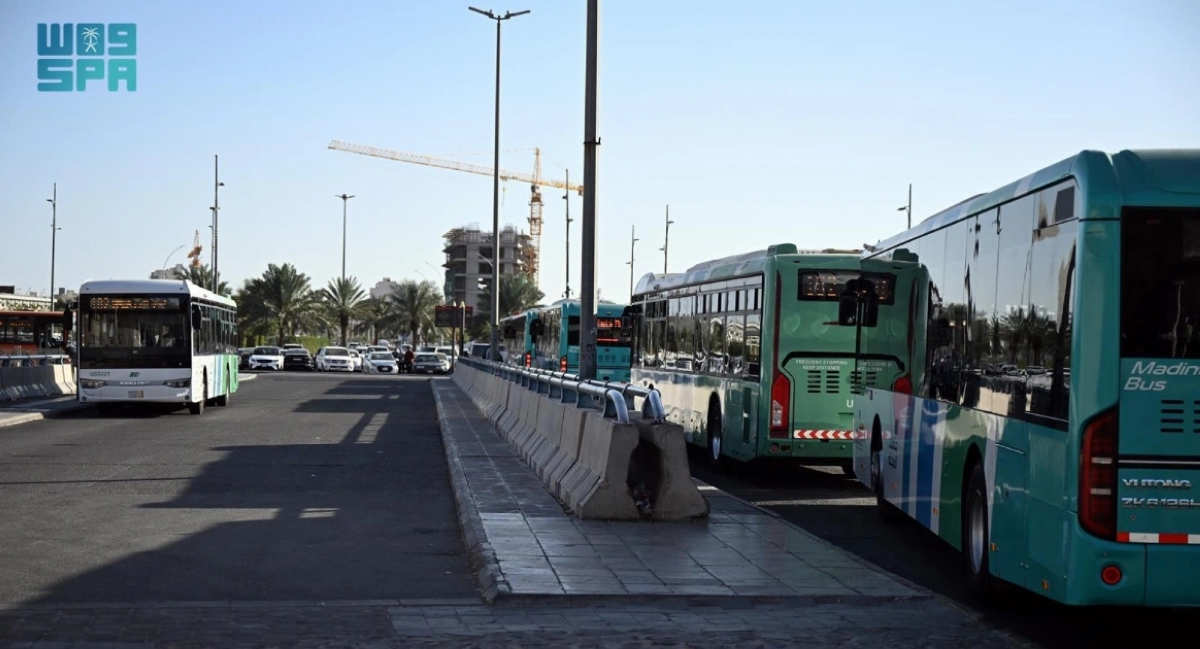
The Medina Bus Project announced on Sunday an updated schedule that includes 15 new routes for public transport services, aimed at facilitating the movement of residents, visitors, and pilgrims in the holy city. This project, supervised by the Royal Commission for Medina, seeks to enhance the commuting experience in the city, especially with the increasing number of visitors during the Hajj and Umrah seasons.
The new schedule divides the routes into two groups, with the first group consisting of five routes that operate around the clock. These routes are: Medina Airport – Prophet's Mosque (400), Miqat – High-Speed Rail (130), Al-Faisaliah – Wadi Madenib (150), Sayed Al-Shohada Square – Al-Ulya (190), and Al-Khalidiyah – Al-Qaswa (191). The second group includes ten routes that operate for 18 hours daily, from 6:00 AM to 11:59 PM.
Details of the New Routes
The ten routes in the second group include: Al-Khandaq – Quran Printing Press (230), Al-Faisaliah – Miqat (231), Mount Uhud – Al-Dhayitha (290), Miqat – Industrial Cities (291), Mahzur – Bustan Al-Safiya (310), King Fahd Neighborhood – Quba Mosque (390), Al-Shouran – Al-Areedh Neighborhood (391), Al-Mab'outh – Oasis of Eyes (450), in addition to Airport Area – Al-Ulya (490) and Al-Ulya – Al-Qaswa (590).
This new schedule is part of the efforts by the relevant authorities to develop the public transport system in Medina and provide a comfortable and sustainable transport service that meets the needs of millions of visitors annually, especially during the Hajj and Umrah seasons.
Background & Context
Historically, Medina relied on traditional means of transport, which resulted in significant traffic congestion, especially during Hajj seasons. With the increasing number of visitors, it became essential to develop an effective public transport system. Thus, the Medina Bus Project was launched as part of the Saudi Vision 2030, which aims to improve the quality of life and develop infrastructure.
Medina is considered one of the most visited cities in the world, attracting millions of pilgrims and Umrah performers each year. Therefore, improving transport means is a crucial step to meet the needs of visitors and ensure their comfort.
Impact & Consequences
This project is expected to contribute to reducing traffic congestion, improving air quality in the city, and enhancing the visitor experience. Additionally, providing comfortable public transport makes it easier for visitors to move between the religious and historical landmarks in the city.
Moreover, this project reflects the Saudi government's commitment to developing infrastructure and enhancing tourism, which may lead to increased economic revenues for the city.
Regional Significance
The experience of Medina in developing its public transport system serves as a model for other Arab cities facing similar transportation challenges. This initiative could motivate other Arab countries to improve their traffic systems and develop public transport means.
In conclusion, the Medina Bus Project represents an important step towards achieving a future vision for public transport in the Kingdom and reflects ongoing efforts to provide a more livable urban environment.