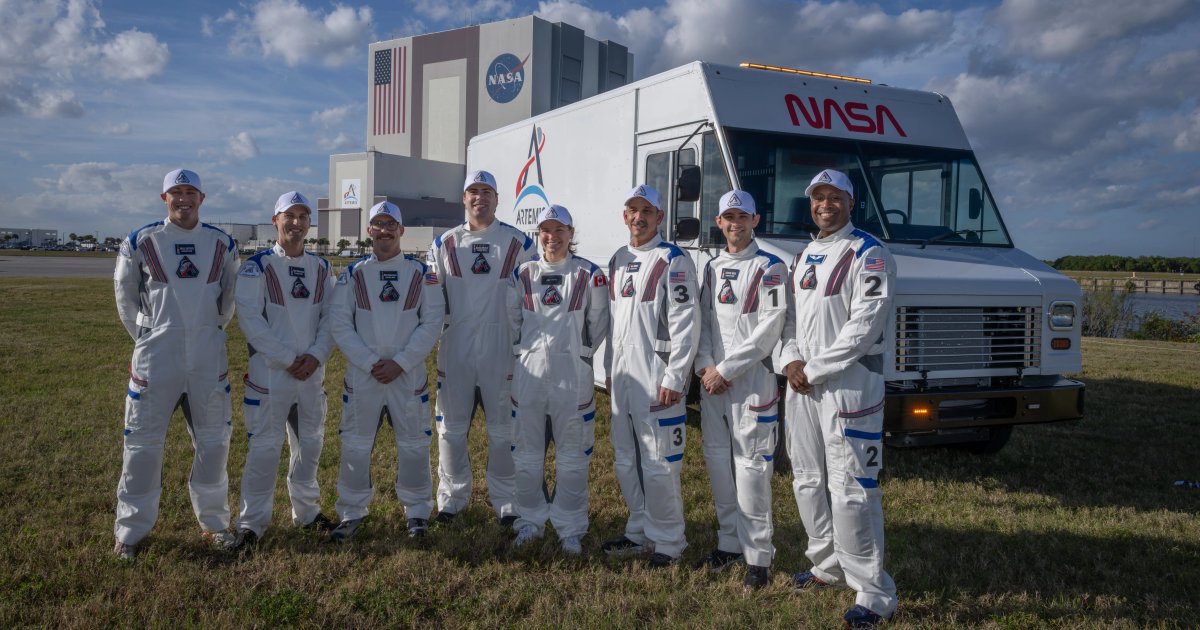
Najoud Miransi, the head of the mission planning department for space exploration at NASA, announced the details of the "Artemis 2" space mission, which will take humans to the farthest point ever reached historically, using the Moon's gravity as a natural engine. This journey represents a unique blend of science, precision, and deep human experience.
In her remarks, Miransi, an American engineer of Palestinian descent, provided a comprehensive vision of how to transform the most complex laws of physics into tools in human hands. Her talk was not merely a technical presentation but an intellectual journey inside the mission's mind, where engineering precision meets boundless human ambition.
Event Details
Miransi plays a pivotal role in the "Artemis" program, describing her work as "coordinating a delicate dance between time and gravity." Every second is calculated with utmost precision, as she emphasized: "We are not drawing a line in space; we are designing a complete human experience." This journey is not just a return to the Moon but a surpassing of all previous achievements, as the spacecraft will reach over 406,000 kilometers from Earth, breaking the record that has stood since the "Apollo 13" mission.
Miransi clarifies that the success of the mission depends on synchronizing two critical factors: the Moon being at "apogee," the farthest point in its orbit, and choosing a "free-return trajectory" that does not require landing. She states: "When you don’t land, you free yourself from the constraints of low orbit and allow physics to take you farther than was possible in the past."
Background & Context
The "Artemis 2" mission is part of a larger program aimed at returning humans to the Moon and exploring deep space. This program represents an important step toward achieving humanity's ambitions in exploring other planets and reflects the technological advancements made by humanity in the field of space.
The mission involves using the concept of a "free-return trajectory," where the "Orion" spacecraft will utilize the Moon's gravity as a natural propulsion force. Miransi explains: "The Moon holds the spacecraft, maneuvers it behind itself, and then gives it the right push toward Earth... We are not resisting gravity; we are using it."
Impact & Consequences
This mission represents a new step toward enhancing international cooperation in the field of space, with many countries participating in developing the technologies necessary for these missions. Additionally, the success of this mission could open doors for further future explorations, including missions to Mars.
However, this return is not without risks, as success depends on entering the atmosphere at a very precise angle. Miransi warns that a steep angle could lead to the spacecraft burning up, while a shallow angle could cause it to bounce back into space.
Regional Significance
The participation of an engineer of Arab descent in such a large-scale project is a source of pride and inspiration for Arabs, reflecting their ability to compete in the fields of science and technology. This mission may also encourage Arab youth to engage in engineering and space fields, contributing to the development of local capabilities.
In conclusion, "Artemis 2" appears not just as a space mission but as an experience that redefines humanity's relationship with the universe. Instead of resisting the laws of nature, humans are learning how to harmonize with them, as Miransi states: "We are not piloting the spacecraft alone... we are sailing in the currents of cosmic gravity."