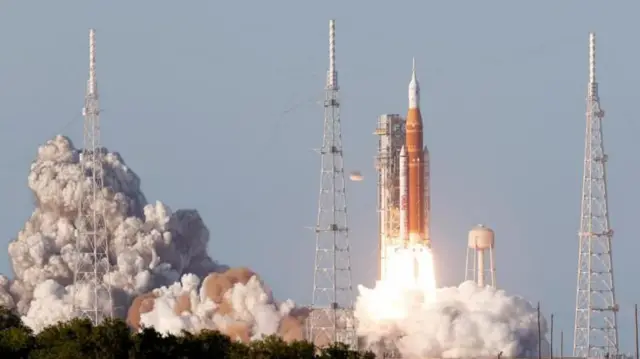
The Artemis 2 space mission successfully launched from Kennedy Space Center, carrying four astronauts on the first crewed flight around the Moon in over 50 years. This mission aims to explore the Moon and pave the way for a permanent base on its surface, marking a significant step in the exploration of outer space.
This mission is part of the Artemis program initiated by the American space agency NASA, which aims to return to the Moon and explore it more deeply. The current mission is part of larger efforts aimed at enhancing human presence on the Moon, paving the way for future missions to Mars.
Details of the Event
The Artemis 2 spacecraft, carrying the astronauts, is on a journey that will last approximately 10 days, during which it will orbit the Moon before returning to Earth. During this journey, the astronauts will conduct scientific experiments and observe the lunar surface, which will help gather the necessary data to identify suitable locations for establishing the permanent base.
The four astronauts participating in the mission are: Christina Koch, John Shoffner, Jeremy Hansen, and Jonathan Freeman. These astronauts represent a diverse range of expertise in the fields of science and engineering, reflecting NASA's modern approach to crew selection.
Background & Context
The last crewed mission to the Moon, Apollo 17, took place in 1972, marking the last time humans landed on the lunar surface. Since then, lunar research has seen significant advancements, with numerous uncrewed missions sent to explore its surface and gather data.
The Artemis program represents a strong return for the United States to lunar exploration and also reflects the increasing competition in space among major nations. In recent years, other countries such as China and Russia have begun developing their own space programs, increasing the significance of this mission for the United States.
Impact & Consequences
The Artemis 2 mission is a strategic step towards enhancing the United States' space capabilities, aiming to achieve both scientific and commercial objectives. Establishing a permanent base on the Moon will enable advanced scientific research and the potential exploitation of lunar resources, such as water and minerals.
Moreover, the success of this mission could enhance international cooperation in space, as other countries may participate in developing the lunar base, opening new avenues for scientific and technological collaboration.
Regional Significance
Although the mission focuses on the Moon, it has potential implications for the Arab region. These achievements in space could encourage Arab nations to invest in their own space programs, enhancing their scientific and technological capabilities.
This mission could also open the door for more collaboration between Arab countries and leading space nations, contributing to the development of joint projects that benefit all parties involved.
The launch of the Artemis 2 mission represents a new beginning for space exploration, reflecting modern trends in this field. As developments continue, there remains hope for achieving new scientific milestones that benefit humanity as a whole.