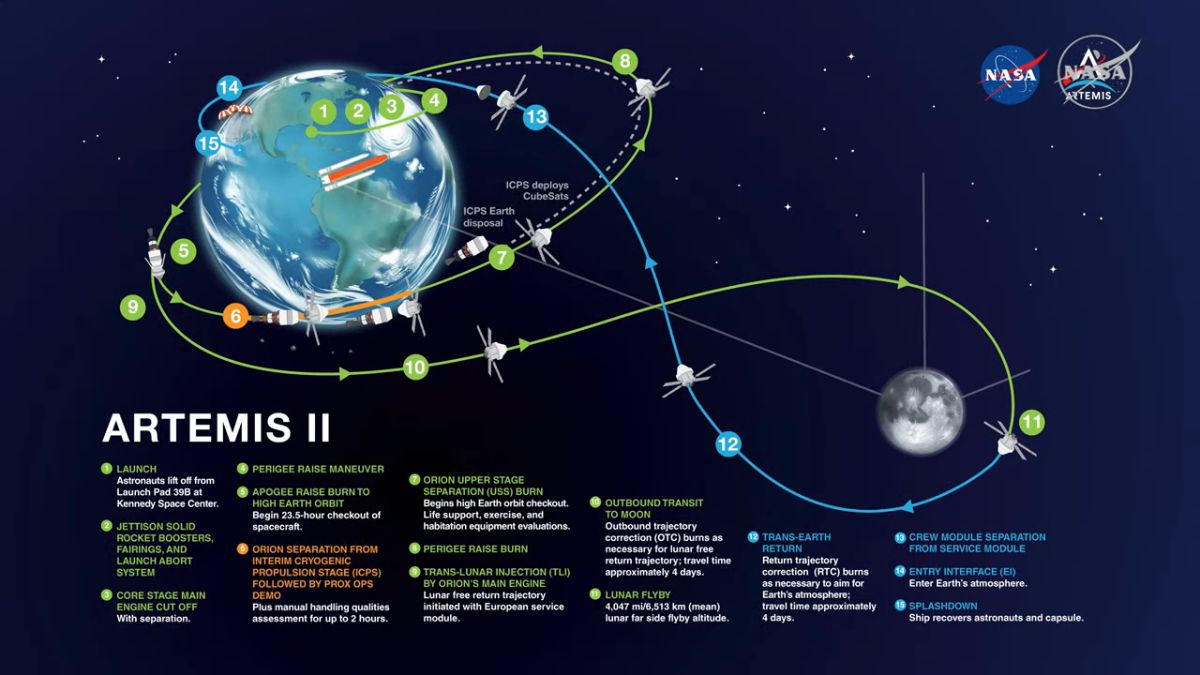
NASA launched the Artemis II mission on Wednesday, April 1, from the Kennedy Space Center in Florida, embarking on a historic journey carrying four astronauts in the first crewed mission to the Moon in over 50 years. This mission represents a significant step in the Artemis program, which aims to return humans to the Moon and explore outer space.
The Space Launch System (SLS) rocket, along with the Orion spacecraft, lifted off at 6:35 PM Eastern Time, beginning a 10-day journey around the Moon before returning to Earth. The mission crew consists of astronauts: Reid Wiseman, Victor Glover, Christina Koch, and Jeremy Hansen from the Canadian Space Agency.
Event Details
Before the launch, the countdown was paused for a few minutes at the T-10 minute mark, but it resumed shortly after. About eight minutes after liftoff, NASA confirmed the successful separation of the SLS rocket's core stage from the upper stage and the Orion spacecraft, marking the end of the first phase of the launch.
Twenty-four minutes after launch, the solar panels of the Orion spacecraft were fully deployed, with each panel containing approximately 15,000 solar cells to convert sunlight into electrical energy. The crew and engineers on the ground began transitioning the spacecraft from launch mode to operational mode to check the main systems.
Approximately 49 minutes into the flight, the upper stage of the SLS rocket was ignited to place Orion into an elliptical orbit around Earth, where the upper stage will perform a second burn to propel Orion into a high orbit extending about 73,600 kilometers above Earth. After this, Orion will continue its mission independently.
On April 6, the astronauts are scheduled to fly around the Moon, capturing images and observing the lunar surface, including remote areas that have never been seen by humans. The crew will also conduct a series of research studies on human health during the mission.
Background & Context
The Artemis II mission is part of the Artemis program launched by NASA in 2017, which aims to return humans to the Moon by 2024. This program responds to technological and research developments in space exploration, as the agency seeks to enhance human presence in outer space and develop new technologies for exploring other planets, including Mars.
Historically, the last crewed mission to the Moon was Apollo 17 in 1972, when astronauts landed on the lunar surface. Since then, no humans have been sent to the Moon, making Artemis II a milestone in the history of space exploration.
Impact & Consequences
The Artemis II mission represents a real test of life-support systems in space, as this mission will help determine how well humans can live and work in extreme space environments. It will also pave the way for more future missions to the Moon and Mars, enhancing humanity's ability to explore space.
This mission is also an opportunity to strengthen international cooperation in space, as the Canadian Space Agency is participating in this mission, reflecting the importance of global partnerships in space exploration.
Regional Significance
Although the Artemis II mission focuses on the Moon, it has potential implications for the Arab region. With the increasing interest in space, Arab countries can benefit from these developments by enhancing their own space programs, such as the UAE's Mars exploration project.
This mission could also encourage collaboration among Arab countries in scientific research and technology, contributing to the development of the region's capabilities in space and modern technology.
In conclusion, the Artemis II mission represents an important step towards space exploration, bringing humanity back to the Moon after more than half a century, opening new horizons for scientific research and international cooperation.