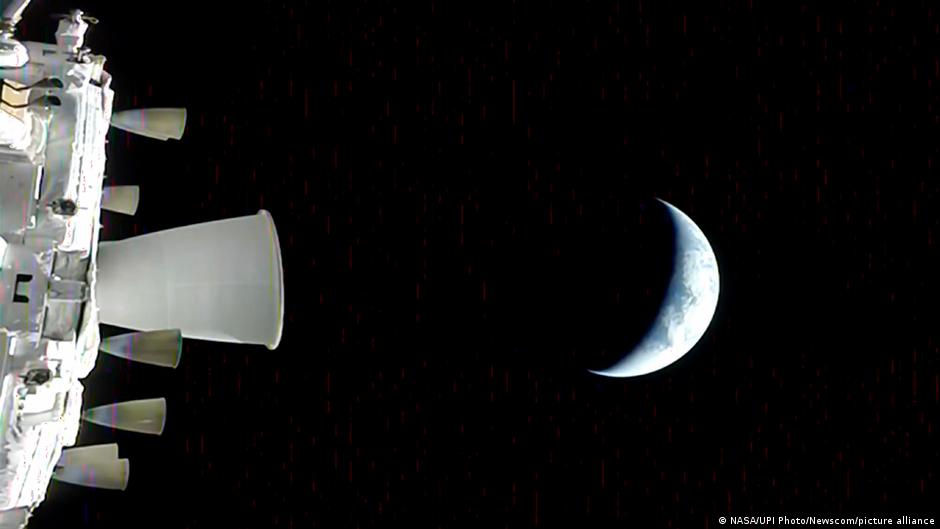
In a historic step, NASA's Artemis II spacecraft has launched towards the moon, with astronauts successfully igniting the engines, allowing them to exit Earth's orbit. This mission represents the first crewed flight around the moon since the Apollo 17 mission in 1972.
The mission control center in Houston announced the successful launch, which occurred 25 hours after the giant rocket carrying the Orion capsule lifted off from the Kennedy Space Center in Florida. Canadian astronaut Jeremy Hansen expressed his amazement, stating, "We are seeing the dark side of Earth illuminated by the moonlight; it’s a stunning sight."
Event Details
The Artemis II crew consists of four astronauts: three Americans and one Canadian. They are commander Reid Wiseman, pilot Victor Glover, astronaut Christina Koch, and Jeremy Hansen. After departing Earth, the astronauts tested the cameras and navigated their Orion spacecraft, encountering minor issues such as a toilet malfunction and email problems, which were later resolved.
This ten-day mission aims to achieve the farthest distance traveled by humans in space, reaching approximately 252,000 miles (406,000 kilometers), surpassing the record set by Apollo 13 in 1970. The astronauts will need to test the Orion spacecraft, designed for deep space exploration, in preparation for a potential moon landing in 2028 and future missions to Mars.
Background & Context
The Artemis II mission is part of the Artemis program, which aims to return humans to the moon—an ambitious project through which NASA seeks to achieve new milestones in space exploration. After more than 50 years since the last crewed mission to the moon, Artemis II marks the beginning of a new era of space exploration, as the agency aims to achieve its goals of exploring both the moon and Mars.
This mission also includes several historical milestones, such as the participation of the first female astronaut, the first Black astronaut, and the first non-American astronaut in a lunar mission. These achievements reflect diversity and inclusivity in the field of space, representing a significant step towards achieving equity in this sector.
Impact & Consequences
The Artemis II mission is a landmark in the history of space exploration, reigniting human ambitions to explore outer space. The success of this mission will enhance humanity's ability to achieve new accomplishments in space, potentially leading to more complex future explorations, including missions to Mars.
This mission also represents an opportunity to enhance international cooperation in space, as it may encourage other countries to participate in space exploration projects, fostering understanding and collaboration among nations.
Regional Significance
Although this mission focuses on outer space, it has potential impacts on the Arab region. These achievements could inspire Arab youth in the fields of science, technology, engineering, and mathematics, enhancing opportunities for innovation and development in these areas.
Moreover, these projects could contribute to strengthening Arab cooperation in space, as Arab countries may collaborate in developing their own space programs, contributing to sustainable development in the region.
The launch of the Artemis II mission towards the moon represents a historic step in space exploration, reflecting human ambitions to achieve new accomplishments. The success of this mission could open new horizons for international cooperation and enhance the role of Arab youth in science and technology.