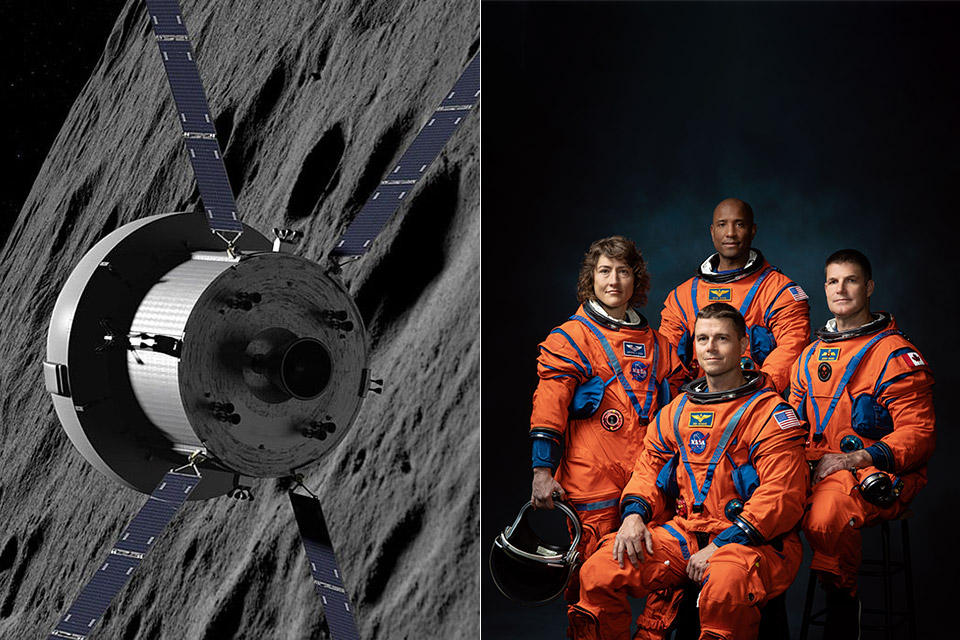
NASA has announced that the Artemis II capsule, which carries four astronauts, performed a critical maneuver last Thursday, enabling the crew to exit Earth's orbit and head towards the Moon. This step marks the beginning of a historic journey aimed at achieving the farthest distance humans have traveled in space, surpassing the record set by the Apollo 13 mission in 1970.
After launching from Florida 26 hours earlier, the astronauts spent their first day in space testing cameras and navigating the Orion capsule, in addition to addressing some minor issues related to the bathroom and email that were resolved later.
Details of the Event
The capsule was in an elliptical orbit around Earth, reaching a distance of 43,000 miles (64,000 kilometers) from Earth at one end of the orbit, before beginning a propulsion maneuver known as the "trans-lunar burn." This maneuver, which commenced at 7:49 PM Eastern Time, serves as an exit from Earth's orbit, as the capsule will head towards a figure-eight trajectory towards the Moon.
Mission Commander Reid Wiseman stated that during their journey, they saw Earth as a glowing sphere shrinking on the horizon, noting that capturing images from that distance was challenging due to the difficulty in adjusting exposure settings.
Background & Context
The Artemis II mission is part of the Artemis program, which aims to return humans to the Moon by 2024, as part of a larger vision for deep space exploration. Following the success of the uncrewed Artemis I mission, this mission marks the first to carry astronauts, reflecting significant progress in NASA's efforts to explore both the Moon and Mars.
The history of space exploration is filled with challenges and achievements, with the Apollo missions of the 1960s and 1970s representing major leaps in the field. However, the technology used today, such as the advanced global waste management system in the Orion capsule, reflects the significant advancements that have occurred since then.
Impact & Consequences
This mission is a crucial step towards achieving space exploration goals, as it will help gather the necessary data for a better understanding of the lunar environment, paving the way for the establishment of permanent bases on the Moon. Additionally, the success of this mission could enhance international cooperation in space, as many countries seek to participate in deep space exploration.
Moreover, the use of modern technology such as smartphones and "GoPro" cameras to document the journey reflects how technology can play a role in enhancing astronauts' experiences and documenting their achievements.
Regional Significance
Although the Artemis II mission focuses on the Moon, its success could positively impact Arab countries seeking to develop their space programs. Many Arab nations, such as the United Arab Emirates, have launched their own space projects, indicating a growing interest in space exploration.
This mission could inspire new generations in the Arab world to engage in the fields of science, technology, engineering, and mathematics, fostering innovation and development in the region.