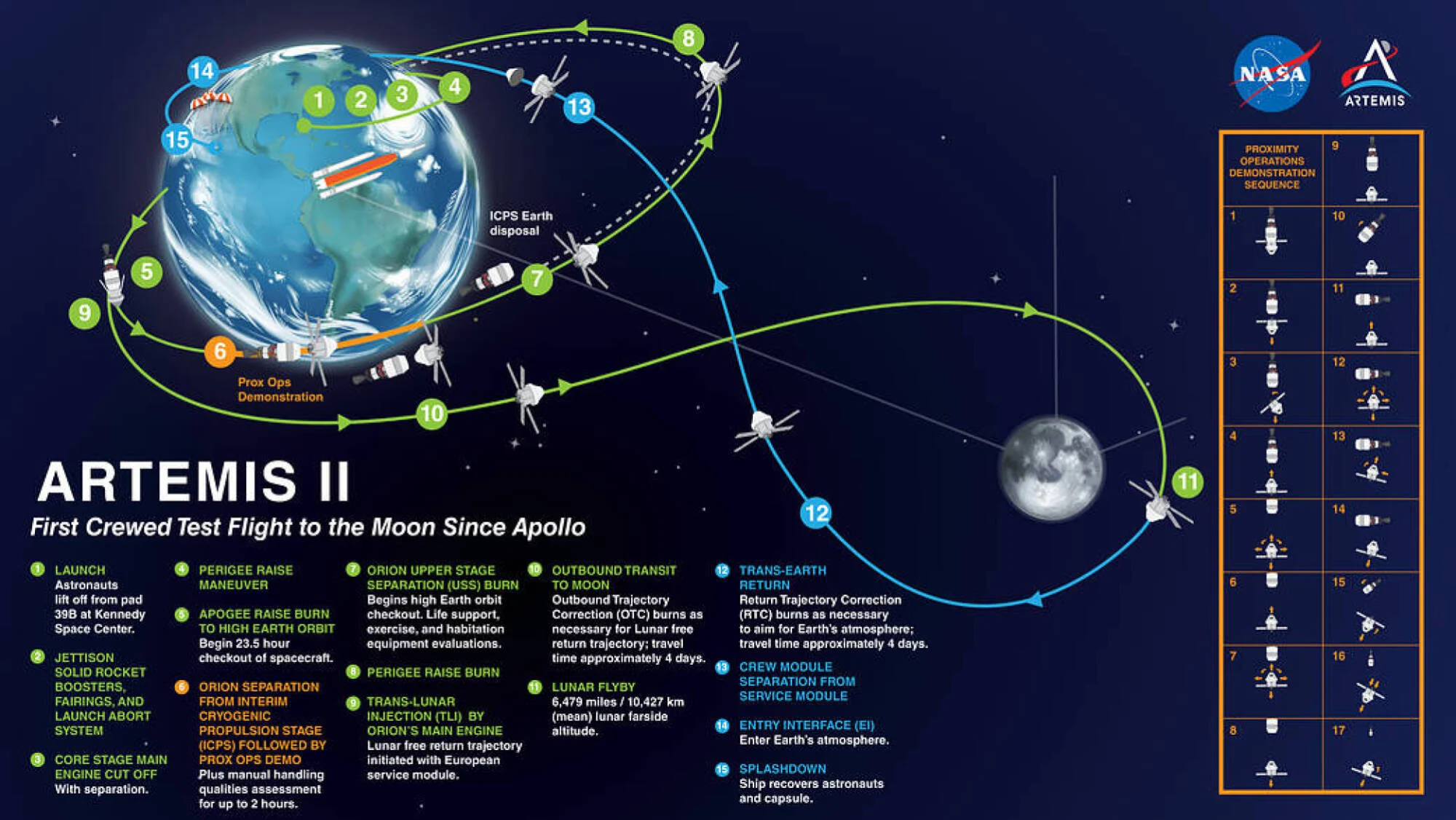
The Artemis 2 mission, representing an important step in the space exploration program, has taken off, with the spacecraft set to orbit the Moon before returning to Earth. Authorities have confirmed that changing the spacecraft's trajectory during the flight is impossible, meaning that gravity will dictate the return path.
This mission is part of NASA's efforts to return humans to the Moon, aiming to enhance human capabilities in exploring outer space. It is expected that this mission will contribute to the development of the necessary technology for future trips to Mars and other space destinations.
Event Details
The Artemis 2 mission is the first crewed mission since the Apollo program, which sent astronauts to the Moon in the 1960s and 1970s. The spacecraft will carry a crew of four astronauts, who will orbit the Moon before returning to Earth. The spacecraft has been equipped with the latest technologies to ensure the crew's safety during the flight.
The mission is expected to last approximately 10 days, during which the spacecraft will fly at various altitudes around the Moon, allowing the crew to conduct scientific experiments and closely observe the lunar surface. The spacecraft will also gather important data about the space environment, which will aid in planning future missions.
Background & Context
This mission is part of the Artemis program launched by NASA in 2019, which aims to return humans to the Moon by 2024. The program is designed to expand the scope of space exploration and enhance international cooperation in this field. It also seeks to achieve scientific and educational goals by engaging the next generation of scientists and engineers.
Returning to the Moon is a strategic step, as scientists aim to study the natural resources present there, such as water and mineral materials, which could be beneficial in supporting future missions to Mars.
Impact & Consequences
The Artemis 2 mission is a milestone in the history of space exploration, reflecting technological advancement and innovation in this field. It also reinforces the United States' position as a leading power in space exploration, which may lead to increased international cooperation in this domain.
This mission is expected to inspire future generations of scientists and engineers, encouraging them to engage in the fields of science and technology. It will also contribute to enhancing public understanding of the importance of space exploration and its impact on life on Earth.
Regional Significance
Space exploration programs present an opportunity for Arab countries to enhance their capabilities in science and technology. Arab nations can benefit from collaborating with global space agencies, such as NASA, to develop their own space programs.
The success of the Artemis 2 mission may encourage Arab countries to invest in space projects, contributing to sustainable development and fostering innovation in the region.
In conclusion, the Artemis 2 mission represents an important step toward a bright future in space exploration, reflecting humanity's commitment to expanding the horizons of knowledge and technology.