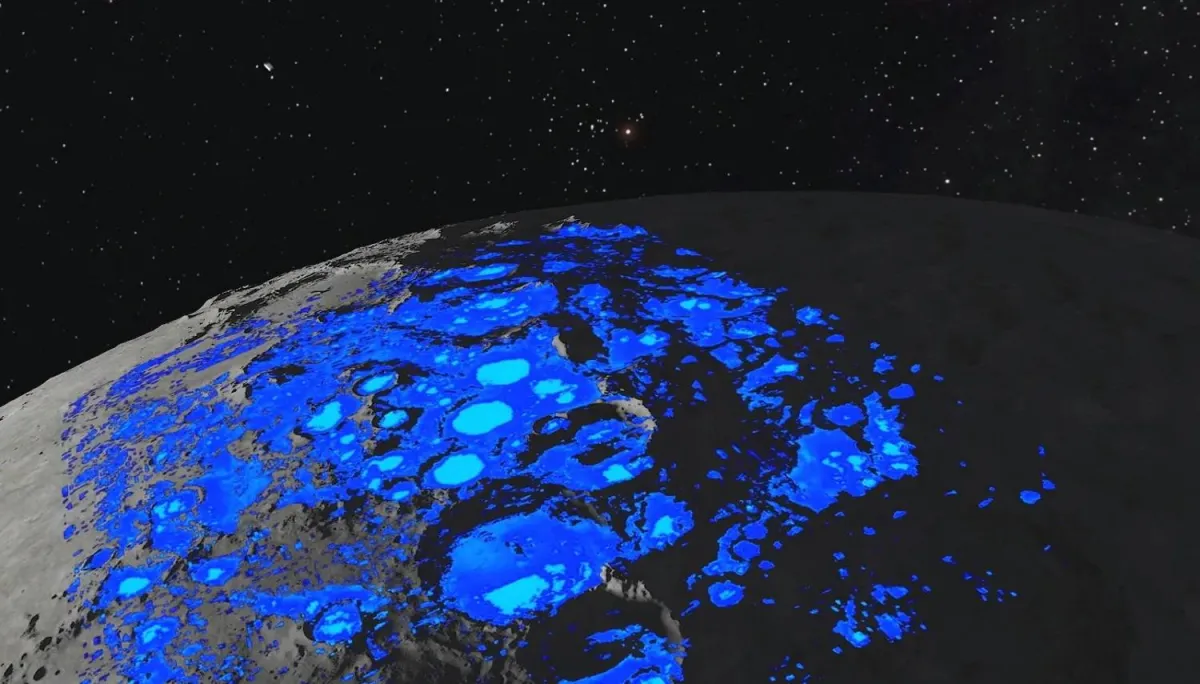
An international team of researchers, including the Laboratory for Atmospheric and Space Physics at the University of Colorado Boulder, has revealed a new map that precisely details the distribution of ice on the Moon's surface. These findings could be crucial in helping future astronauts identify the best locations for obtaining water, which is essential for any future space mission.
The researchers clarified that water on the Moon has gradually accumulated over billions of years, rather than being the result of a single massive event as previously thought. The results were published in a specialized scientific journal, showing that ice is primarily found in deep, dark craters near the south pole, areas that never receive sunlight.
Event Details
The presence of water on the Moon has long been a mystery that has puzzled scientists, particularly in the form of ice preserved within deep craters. Data from NASA missions suggest the possibility of large quantities of ice in these regions, making them an ideal environment for ice preservation for billions of years. However, the source of this ice and how it reached certain craters remains enigmatic.
Utilizing data from NASA's Lunar Reconnaissance Orbiter, along with advanced computer simulations, the team achieved precise results that reshape scientists' understanding of water presence on the Moon. The findings revealed that lunar ice primarily accumulates within deep, dark craters near the south pole, where sunlight has not reached for billions of years.
Background & Context
Historically, the prevailing hypothesis suggested that water arrived on the Moon as a result of a massive comet impact on its surface. However, the new study dismisses this hypothesis, instead favoring several potential sources, including ancient volcanic activity that may have transported water from the Moon's interior to its surface, impacts from comets and asteroids, and solar winds carrying hydrogen atoms.
The distribution of ice on the Moon is not uniform, which has remained a long-standing mystery. Recent simulations revealed that some craters were not always dark; their conditions changed as the Moon's tilt varied over time, affecting their ability to retain ice. The study identified several strongly candidate sites likely to contain significant amounts of ice, notably the Haworth crater, which is believed to have remained in shadow for over 3 billion years.
Impact & Consequences
The presence of water on the Moon is considered a strategic treasure for future space missions, as it could support the establishment of permanent human bases and reduce the need to transport resources from Earth. Additionally, this water could be used for drinking or to produce rocket fuel by separating hydrogen and oxygen.
Researchers are currently working on developing a new device to monitor ice more accurately, scheduled to be sent to the Moon's south pole by 2027. Scientists emphasize that a definitive resolution regarding the source of water on the Moon requires direct analysis of samples from these craters, either through in-situ studies or by returning them to Earth.
Regional Significance
These discoveries hold particular importance for the Arab region, as they may open new avenues for cooperation in space and scientific research. The presence of water on the Moon could enhance Arab space programs and strengthen the ability of Arab countries to participate in space exploration.
In conclusion, this research represents a significant step towards a deeper understanding of the presence of water on the Moon and enhances opportunities for space exploration in general.