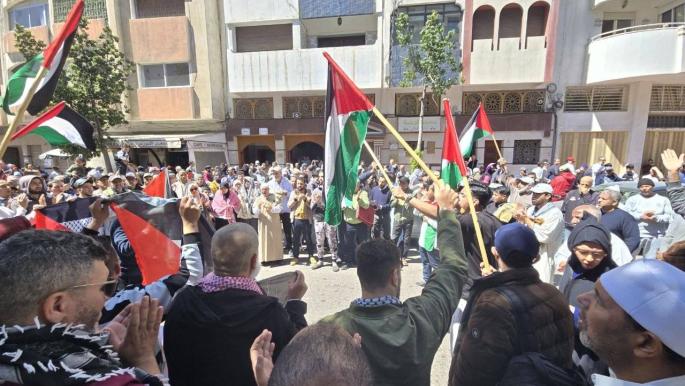
On Saturday, several Moroccan cities witnessed massive protests involving thousands of citizens, in response to the Israeli Knesset's recent law permitting the execution of Palestinian prisoners. The demonstrators expressed their outrage over the continued closure of Al-Aqsa Mosque, emphasizing the necessity of supporting the Palestinian cause amid ongoing violations.
These protests come at a sensitive time, as Palestinians face significant challenges due to the ongoing Israeli escalation. Protesters gathered at various locations, including the capital, Rabat, and other cities such as Casablanca and Marrakech, holding banners that expressed solidarity with Palestinian prisoners and condemned laws threatening their lives.
Event Details
The demonstrators assembled at the United Nations Square in Rabat, where several political and human rights figures delivered speeches highlighting the importance of Arab unity in confronting occupation. Press releases were distributed, calling on the international community to intervene to stop these violations. Protesters raised slogans demanding the release of prisoners and the reopening of Al-Aqsa Mosque to worshippers.
These protests coincided with calls from international human rights organizations to denounce Israeli laws targeting Palestinians, reflecting growing international concern regarding human rights in the occupied territories.
Background & Context
Historically, the Palestinian issue has witnessed numerous violations by the Israeli occupation, including arbitrary arrests and extrajudicial executions. The law permitting the execution of Palestinian prisoners, passed by the Knesset, represents a new escalation in this context, aiming to tighten penalties on Palestinian prisoners, thereby increasing their suffering.
On the other hand, the closure of Al-Aqsa Mosque is part of an Israeli policy aimed at altering the status quo in the holy city, which provokes anger among Muslims worldwide. Al-Aqsa Mosque is a significant religious and historical symbol, recognized as one of the two Qiblas and the third holiest site in Islam.
Impact & Consequences
These protests serve as a strong message from the Moroccan people to the Israeli government and the international community that the Palestinian cause remains present in Arab consciousness. Additionally, these grassroots movements reflect a strong desire to support Palestinian rights, which may contribute to enhancing Arab solidarity.
On the international stage, these protests could increase pressure on Western governments to intervene and take responsibility for what is happening in Palestine. They may also stimulate discussions about human rights in international forums.
Regional Significance
The Palestinian issue is a central focus in Arab politics, and any escalation in this matter directly affects relations between Arab states and Israel. The protests in Morocco may inspire other countries in the region to act and support the Palestinian cause, thereby strengthening the Arab position against occupation.
Ultimately, the Palestinian issue remains a central concern in the Arab world, and the support from Moroccans reflects their steadfast commitment to the rights of the Palestinian people. These popular movements express Arab unity in facing the challenges they encounter.