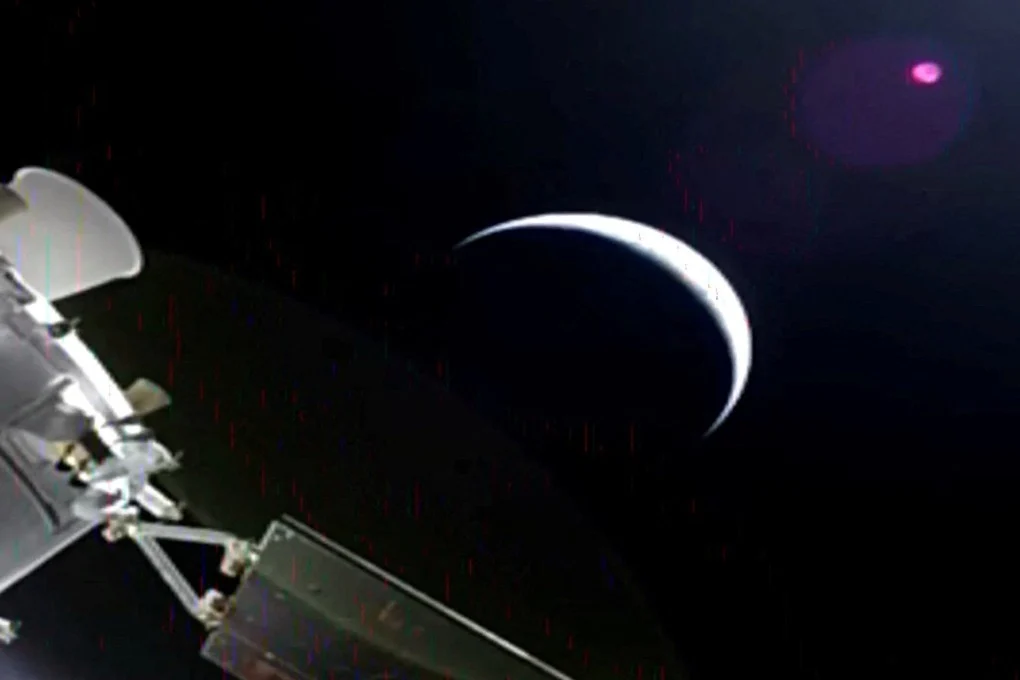
NASA, the United States space agency, has announced that it has granted the green light for the Artemis crew, consisting of four astronauts, to launch towards the Moon. This historic mission will witness the first crewed flight around the Moon in over 50 years. The announcement was made during a press conference, where NASA's flight director, Jeff Radigan, confirmed that the mission management team approved the ignition of the Orion capsule's engine to send the spacecraft towards the Moon.
The engine is scheduled to be activated for 5 minutes and 49 seconds at exactly 7:49 PM EST, allowing the astronauts to exit Earth's orbit and commence their journey to the Moon. This mission represents a significant step in the Artemis program, which aims to return humans to the Moon and explore further into space.
Mission Details
The Artemis mission comprises four astronauts: Ariana Fletcher, Mark Tait, Sarah Johnson, and David Kim, who will embark on a journey around the Moon, flying over its surface at a low altitude. This mission is not merely an exploratory flight; it aims to test new technologies and conduct scientific research that could benefit future endeavors.
This mission is part of a larger plan to establish a permanent base on the Moon by the end of this decade, enabling humanity to explore Mars in the near future. Furthermore, this flight signifies humanity's return to the Moon after a hiatus of over half a century.
Background & Context
The history of lunar exploration dates back to 1969 when American astronauts first landed on its surface during the Apollo 11 mission. Since then, there have been no crewed flights to the Moon, making this mission a milestone in space history. The Artemis program is part of NASA's efforts to regain leadership in space exploration and reflects the global trend towards exploring outer space.
Many countries, including China and Russia, are seeking to enhance their space programs, increasing the importance of this mission for the United States. The success of the Artemis program could bolster the United States' standing as a leading power in space.
Impact & Consequences
This mission is a crucial step towards achieving NASA's goals in space exploration, as it will contribute to the development of new technologies that may be essential for future missions to Mars. Additionally, this mission will allow scientists to gather new data about the Moon, which could help in better understanding the history of the solar system.
Moreover, the success of this mission could encourage further investments in the space sector, both from the public and private sectors, potentially leading to more innovations and technological advancements.
Regional Significance
Although this mission pertains to the United States, it has potential implications for the Arab region. It may encourage Arab nations to enhance their space programs, especially with the growing interest in scientific and technological explorations in the region. Furthermore, international cooperation in space could open new avenues for Arab countries to participate in future exploratory projects.
In conclusion, the Artemis mission represents a significant step towards space exploration, paving the way for further scientific and technological discoveries that could benefit all of humanity.