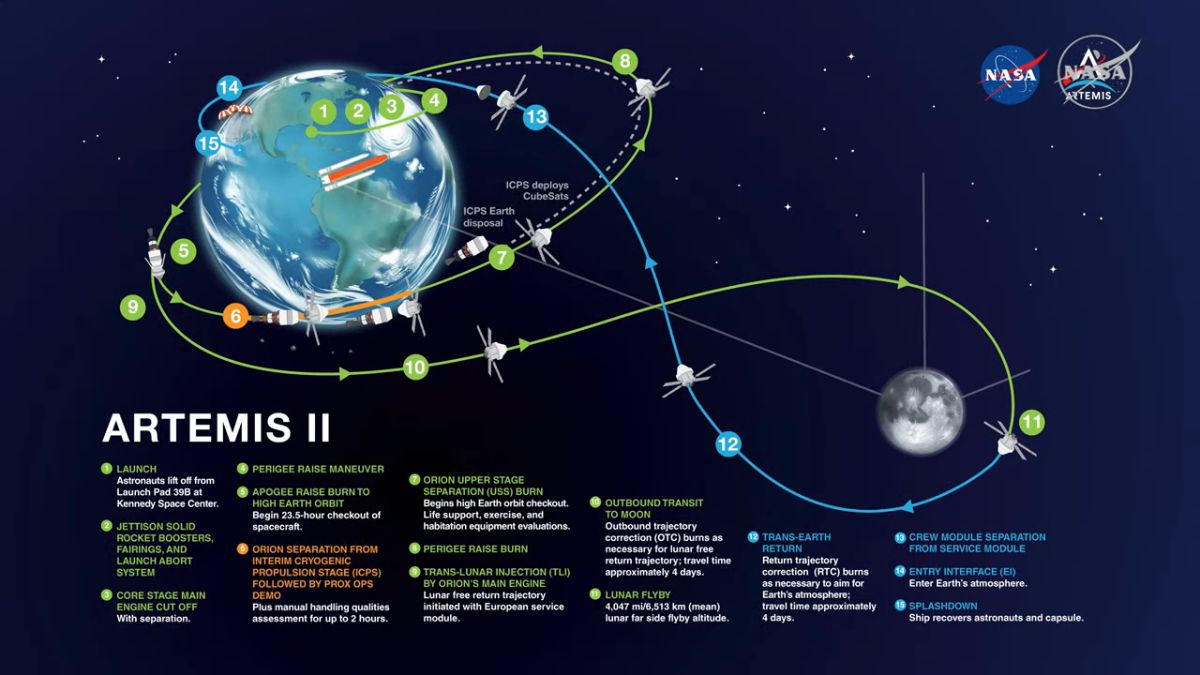
NASA is gearing up for the launch of the Artemis 2 mission, which is part of the Artemis program aimed at returning humans to the Moon by 2024. This mission not only represents a scientific achievement but also reflects the increasing interest from Middle Eastern countries in space exploration, opening new horizons for scientific and technological cooperation.
Scheduled for launch in 2024, the Orion spacecraft will carry astronauts on a journey around the Moon. This mission will serve as a real test for the technologies used in future explorations, including trips to Mars. Furthermore, this step comes at a time when the world is witnessing a growing interest in space sciences.
Event Details
The Artemis 2 mission will include four astronauts who will conduct scientific experiments during their journey. This mission is part of a larger program aimed at establishing a base on the Moon, which will support future explorations. NASA hopes that this mission will contribute to enhancing international cooperation in the field of space.
In recent years, Middle Eastern countries have begun to bolster their investments in space, with the United Arab Emirates launching its space program that includes sending a probe to Mars. Saudi Arabia has also announced plans to establish its own space agency, reflecting the regional trend towards space exploration.
Background & Context
Historically, space programs have been limited to a few advanced countries. However, with technological advancements, new countries have started to enter this field. In 2020, the United Arab Emirates launched the Hope Probe to Mars, making it the first Arab country to reach the Red Planet. This achievement has inspired many other Arab countries to develop their own space programs.
These movements are part of a broader vision aimed at enhancing innovation and technology in the region. There is also an increasing interest in cooperation among Arab countries in the fields of science and technology, which enhances the chances of success in space exploration.
Impact & Consequences
The Artemis 2 mission is a significant step towards enhancing international cooperation in the field of space. This mission is expected to lead to the development of new technologies that can benefit all countries, including those seeking to develop their own space programs. Additionally, collaboration in this field can contribute to strengthening relationships between different nations.
Moreover, the success of this mission could encourage more countries to invest in space sciences, leading to the development of new capabilities in areas such as communications, navigation, and scientific research. This could have a positive impact on the global economy.
Regional Significance
The efforts of Middle Eastern countries in space exploration are part of a broader strategy to promote sustainable development and innovation. With increasing investments in this field, the region could become a hub for research and development in space sciences, contributing to achieving sustainable development goals.
Furthermore, cooperation among Arab countries in the field of space can enhance their standing on the international stage and increase their capacity to participate in global projects. This collaboration could also open new avenues for education and training in the fields of science and technology.
In conclusion, the Artemis 2 mission represents a new beginning for an era of space exploration, not only for the United States but also for Middle Eastern countries seeking to enhance their role in this field. With growing interest and investment in space sciences, we may see a bright future for the region in this domain.