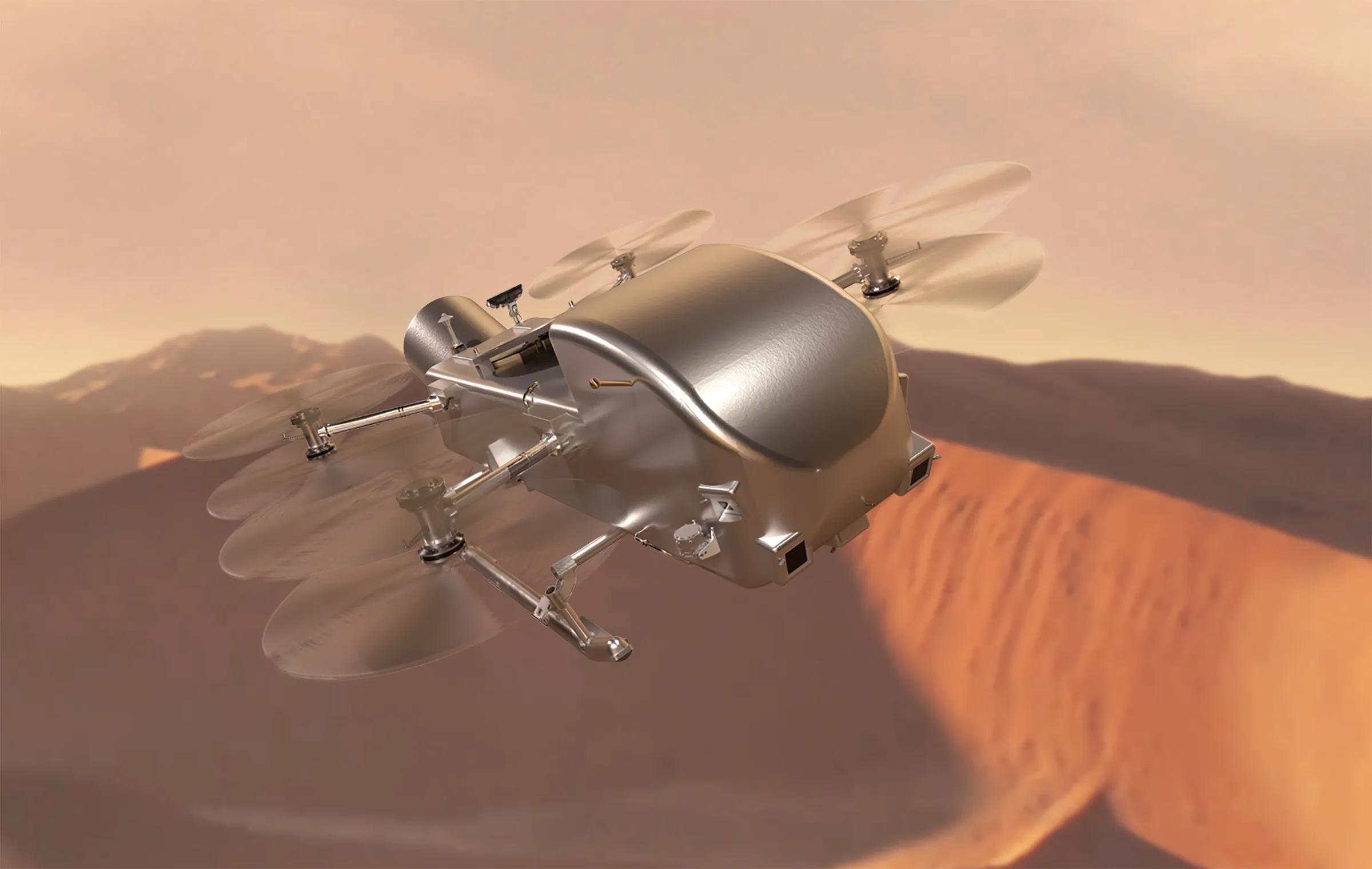
The landing process on any planet or moon is one of the most perilous stages in space missions, as spacecraft are subjected to immense heat due to friction with atmospheric particles. In an effort to understand how to protect spacecraft and ensure their safety, scientists conducted experiments on the thermal shields of spacecraft to study their behavior when entering different atmospheres, as is the case with the planned launch of the 'Dragonfly' helicopter mission to Saturn's giant moon Titan in two years.
A team of researchers led by Professor Francesco Panerai from the University of Illinois Urbana-Champaign conducted experiments using the Plasmatron X wind tunnel to simulate spacecraft entry into Titan's atmosphere. The results showed that thermal shields "breathe" upon atmospheric entry, meaning that the outer layer begins to burn and disintegrate in a process known as ablation.
Details of the Event
When oxygen is present in the atmosphere, the ablation process is stable, with the material eroding uniformly and particles being expelled continuously. However, when oxygen is removed, the process turns into intermittent explosions of particles, which can sometimes become violent, a behavior that researchers had not observed before in over 15 years of studies.
These findings provide a new understanding of material behavior at extreme temperatures, allowing scientists to design better and safer thermal shields for future mission vehicles, especially the 'Dragonfly' mission set for launch in 2028 to Titan.
Background & Context
The 'Dragonfly' mission aims to study Titan's surface with its rotorcraft, including hydrocarbon lakes and rivers, in search of organic molecules that could be precursors to life. The spacecraft will move across different surface regions, allowing for the study of atmospheric and surface changes over a longer duration than previous data.
Titan's atmosphere is characterized by its density, primarily composed of 95% nitrogen and 5% methane, making it vastly different from Earth's atmosphere. This difference makes studying the behavior of thermal shields in this environment essential to ensure the vehicle's safety during high-speed atmospheric entry.
Impact & Consequences
Although the Huygens probe landed on Titan in 2005 aboard the Cassini spacecraft, it landed in a specific area and recorded important data, but it was limited in geographical and temporal coverage. The new study aims to understand atmospheric and surface behavior in greater detail and explore multiple areas to observe long-term changes.
The laboratory experiments will simulate the dynamic conditions of atmospheric entry at high speeds, an aspect that Huygens did not test, which is crucial for designing safer future missions like 'Dragonfly'. The results of the new study will also help scientists design thermal shields capable of withstanding the dense atmosphere and harsh conditions of any planet or moon, including Titan or even the more hostile Venus.
Regional Significance
This research opens new horizons for understanding how organic molecules form and the potential for life in unfamiliar environments. Additionally, the development of new technologies in the field of space could contribute to enhancing scientific collaboration between Arab nations and advanced countries in this domain.
In conclusion, this research illustrates that spacecraft design is not limited to merely reaching the surface; it requires a thorough study of the atmosphere and material properties under extreme conditions. Titan, with its hydrocarbon lakes and rivers, represents a unique window into understanding how organic molecules form and the potential for life, aiding in the development of safer and more effective space missions in the future.