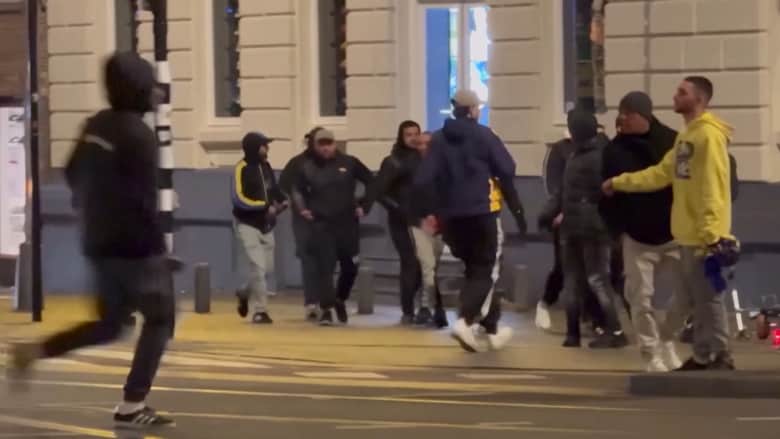
On Tuesday, the Spanish capital, Madrid, saw a significant protest organized by activists opposing the Israeli occupation, just before the basketball match between Spain's Real Madrid and Israel's Hapoel Tel Aviv. Protesters gathered outside the Movistar Arena, where the match was scheduled as part of the 33rd round of the European Basketball League.
The match, which was expected to attract a large audience, was held without fans following consultations between the Spanish government and the Madrid police, a move aimed at avoiding any tensions that might arise from the Israeli team's presence in the country. The demonstrators carried Palestinian flags and banners expressing their rejection of Israeli policies towards Palestinians, reflecting the growing anger in Spanish society towards the occupation.
Details of the Event
The protesters gathered early on the day of the match, chanting slogans calling for support for Palestinian rights and rejecting normalization with Israel. The demonstration saw widespread participation from various age groups, indicating an increasing public awareness of the Palestinian issue in Spain. Additional security forces were deployed to ensure the safety of the protesters and passersby amid fears of potential clashes.
Although the match was to take place in a sporting atmosphere, the current political situation in the region made it difficult to separate sports from politics. Many protesters expressed concern that sports could be used as a means to whitewash the image of the Israeli occupation.
Background & Context
This protest comes at a sensitive time, as international pressure on Israel is increasing due to its policies towards Palestinians. In recent years, there has been a rise in the Boycott, Divestment, Sanctions (BDS) movement against Israel, aimed at pressuring the Israeli government to end the occupation.
Spain, which is considered one of the European countries with a long history of support for the Palestinian cause, has seen an increase in anti-occupation activities in recent years, reflecting a shift in public opinion. Polls have shown that many Spaniards support Palestinian rights and oppose Israeli policies.
Impact & Consequences
These protests could increase pressure on the Spanish government to adopt clearer positions regarding the Israeli occupation. Additionally, these events may contribute to strengthening the boycott movement in Europe, potentially affecting relations between European countries and Israel.
Furthermore, the rise of anti-occupation activities in Spain may encourage other countries in the European Union to take similar stances, leading to changes in foreign policy towards the Palestinian issue.
Regional Significance
These protests in Spain are part of a broader movement supporting Palestinian rights worldwide. They may contribute to enhancing Arab and international solidarity with the Palestinian cause, reflecting a growing global awareness of the suffering of the Palestinian people.
Ultimately, the Palestinian issue remains present in Arab and international consciousness, and protests in Spain and other countries continue to highlight this just cause, reflecting hope for achieving peace and justice.