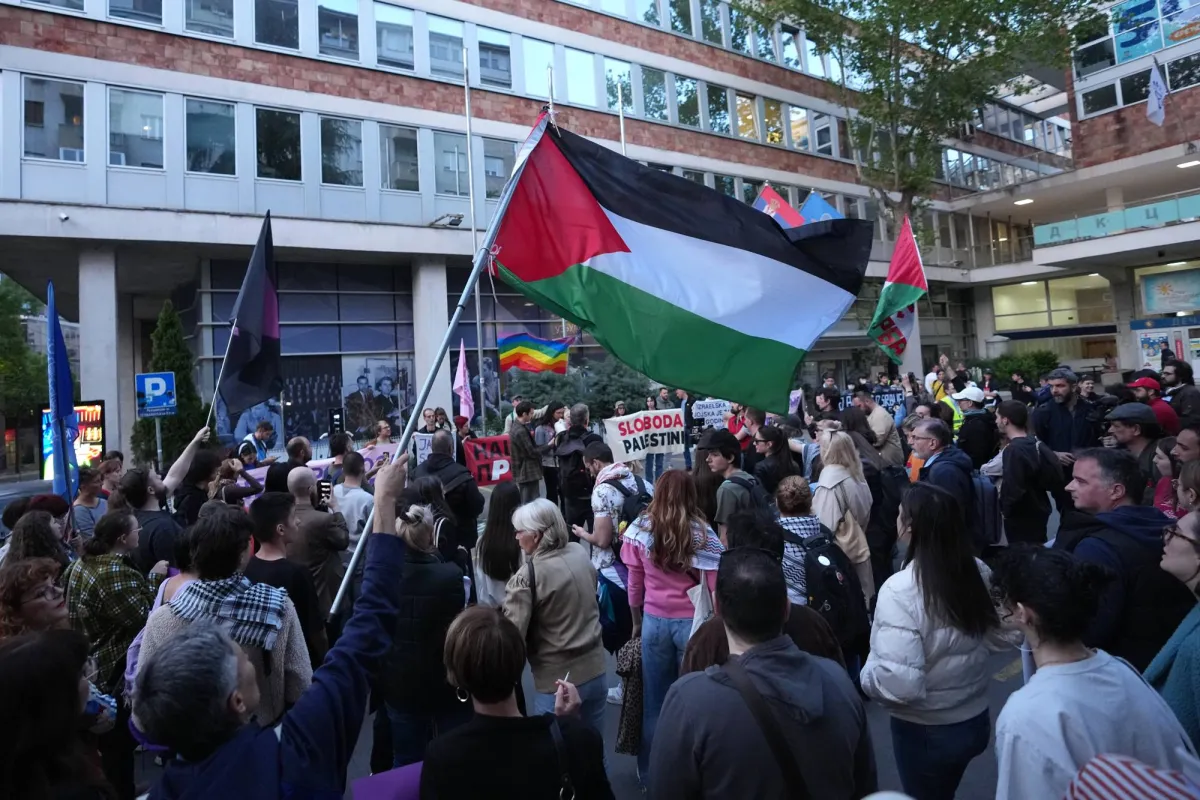
Dozens of protesters gathered outside the Serbian state broadcasting corporation on Tuesday to demand Serbia's withdrawal from the Eurovision Song Contest due to Israel's participation in the event. The demonstrators waved Palestinian flags and held signs bearing slogans condemning Israel and accusing it of committing atrocities during the conflict in Gaza.
This year's Eurovision contest is scheduled to take place from May 12 to 16 in the Austrian capital, Vienna, with participation from 35 countries. Serbia will be represented by the band "Lavinia," a six-member metal music group.
Details of the Protest
During the protest, demonstrators urged the Serbian Broadcasting Corporation not to air the contest and encouraged citizens to refrain from watching it. The organizers of the protest stated: "Eurovision without Israel means defending the ideals proclaimed by this event." Despite the protests, there was no immediate response from the Serbian Broadcasting Corporation, which has close ties with Israel.
The Eurovision Song Contest typically aims to present music away from politics, but it has engaged in political issues several times, such as when Russia was expelled from the contest in 2022 following its invasion of Ukraine. Last December, contest organizers decided to allow Israel to participate, leading to the withdrawal of several countries like Slovenia, Iceland, Ireland, the Netherlands, and Spain.
Background & Context
Eurovision is considered one of the largest music events in the world, bringing together artists from various European countries. However, it is not free from political controversy, reflecting global events and political tensions between nations. In recent years, the contest has seen withdrawals due to political stances, highlighting the impact of politics on culture and the arts.
Protests against Israeli policies are increasing across Europe, especially in light of the recent escalation in the Israeli-Palestinian conflict. This protest in Serbia is part of a broader movement calling for a boycott of events involving Israel, in the context of supporting Palestinian rights.
Impact & Consequences
These protests could affect Serbia's image on the international stage, as it is seen as a country supporting Palestinian rights. They may also lead to increased tensions between Serbia and Israel, especially given the historical relations between the two countries. These events could also impact Serbia's participation in other international events.
These protests are also indicative of how politics intersects with the arts and culture, as protesters seek to use the Eurovision platform to express their political views. Such dynamics may lead to further discussions about the role of art in expressing social and political issues.
Regional Significance
These protests coincide with a rising Arab awareness regarding Palestinian issues, as many activists seek to support Palestinian rights in international forums. Events in Serbia may inspire similar movements in Arab countries, where interest in humanitarian issues and human rights is growing.
In light of these circumstances, Arab countries must closely monitor developments in Europe, as these dynamics could influence Western countries' positions on Arab issues, including the Palestinian cause.