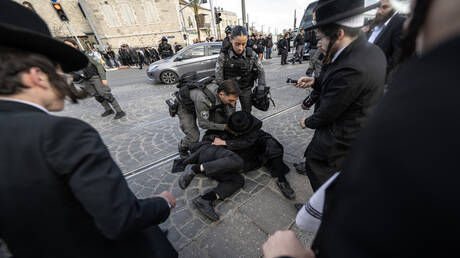
On Tuesday evening, Haredi extremists stormed the home of Brigadier General Yuval Yamin, the Israeli military police chief, in Ashkelon, protesting the resumption of arrests of military service deserters. This incursion has sparked strong reactions within Israeli political and social circles, with some viewing it as a crossing of red lines.
Reports indicate that the extremists threw stones and issued threats, prompting police intervention to disperse the crowd. This incident occurs at a sensitive time, as pressure mounts on the Israeli government regarding its recruitment policies, particularly amid increasing tensions between the government and the Haredi community.
Details of the Incident
On Tuesday evening, a group of Haredi extremists gathered outside Brigadier General Yuval Yamin's home, chanting and displaying anti-arrest slogans. The incident was filmed and shared on social media, intensifying the debate surrounding the rights of military service deserters.
This raid follows a series of protests across the country, where Haredim express their dissatisfaction with government policies on recruitment, which they perceive as a threat to their cultural and religious identity. Some Haredi leaders have pointed out that these policies contradict their values and beliefs.
Background & Context
Historically, there has been a persistent tension between the Israeli government and the Haredi community, which enjoys cultural and religious distinctiveness. Since the establishment of the state, there have been attempts to recruit Haredim into the military, but these efforts have often been met with resistance from the Haredi community, which views military service as a threat to its identity.
In recent years, pressure has increased on the government to enforce stricter recruitment laws, leading to heightened protests from Haredim. These protests reflect dissatisfaction with government policies and demonstrate how political tensions can escalate into violent incidents.
Impact & Consequences
This raid could have significant repercussions on the relationship between the government and the Haredi community. It may lead to an escalation of protests and increased tensions, potentially affecting internal stability in Israel. Additionally, these events could open the door for further discussions regarding the rights of military service deserters.
Moreover, these incidents may impact the Israeli government's image both domestically and internationally, as it will face growing pressure to address these issues more sensitively. International reactions could also play a role in shaping future policies.
Regional Significance
These events hold particular importance for the Arab region, as they reflect internal conflicts within Israeli society. Such tensions may lead to changes in Israeli policies towards Palestinians, especially given the current circumstances in the region.
Furthermore, the escalation of tensions in Israel could affect relations with Arab countries, as some parties may exploit these events to highlight humanitarian and political issues in the region.
The raid on the home of the Israeli military police chief by Haredi extremists underscores the rising tensions within Israeli society and emphasizes the need for comprehensive dialogue to resolve the outstanding issues between the government and the Haredi community.