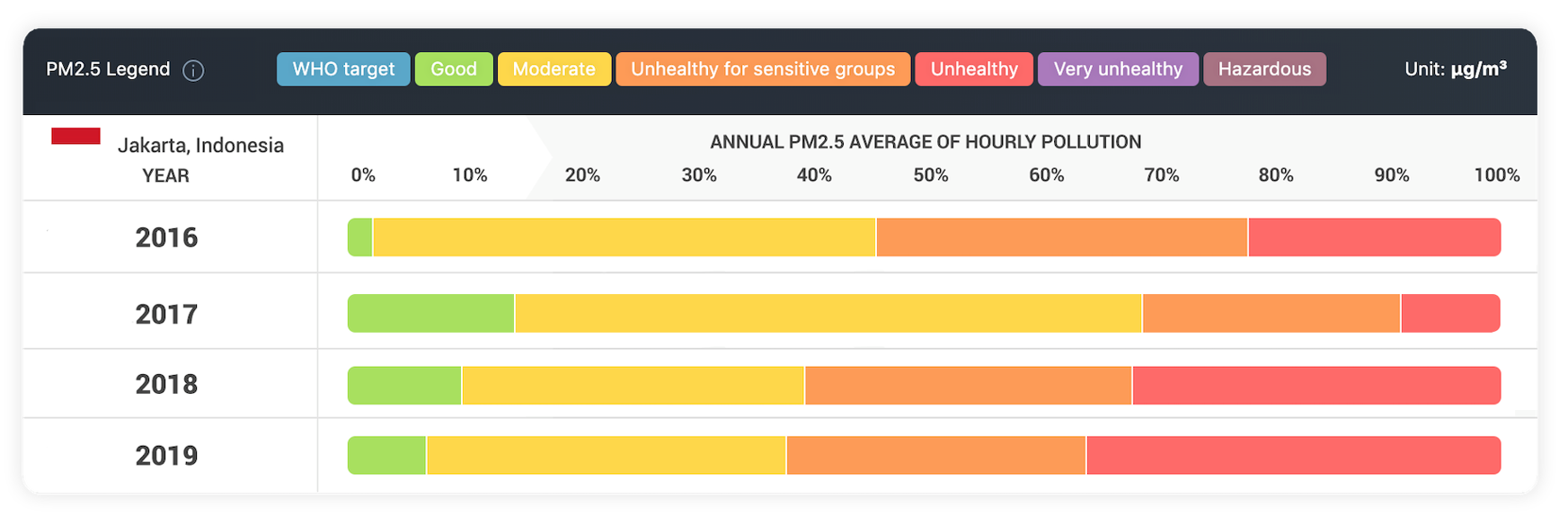
Jakarta, the capital city of Indonesia, has reported a notable decline in air quality this Wednesday morning, as data from IQAir indicates that the air quality index (AQI) has reached 165, placing the city second among those with unhealthy air. These figures emerge as daily activities resume for residents following the Eid al-Fitr holiday of 2026.
The current pollution levels, reflecting concentrations of PM2.5 particles at 70.5 micrograms per cubic meter, are deemed hazardous to human health, particularly for individuals with high sensitivity. Local authorities have warned residents to take necessary precautions, such as wearing masks when leaving their homes.
Details of the Incident
Air quality in Jakarta is an urgent environmental issue, significantly impacted by industrial activities and heavy traffic. Currently, air quality falls under the unhealthy category, meaning that continuous exposure to these levels may lead to serious health problems. Reports have shown that other cities such as Chiang Mai in Thailand, Shanghai in China, and Kolkata in India are also suffering from air pollution, reflecting a widespread environmental crisis in the region.
The Jakarta provincial government is working on rapid strategies to combat air pollution, especially with the anticipated dry season approaching from May to August. These strategies include improving air quality monitoring systems, conducting emissions tests for vehicles, and periodically assessing air pollution control strategies.
Background & Context
Historically, Jakarta has faced significant challenges regarding air quality, with pollution levels rising markedly in recent years. This is attributed to rapid population growth, an increasing number of vehicles, and a lack of green spaces. In past years, the government has taken various steps to address these issues, but progress has been slow.
Air quality in major Southeast Asian cities is a matter requiring international attention, as it affects public health and the environment. Studies have shown that air pollution can lead to increased rates of respiratory and cardiovascular diseases, placing additional strain on healthcare systems.
Impact & Consequences
The repercussions of air pollution in Jakarta are not limited to public health; they also extend to the local economy. As pollution-related illnesses rise, healthcare costs may increase, affecting productivity and placing financial burdens on families. Additionally, deteriorating air quality can negatively impact tourism, as visitors prefer to travel to cities with clean environments.
Furthermore, environmental pollution can affect the overall quality of life, prompting residents to seek healthier places to live. This may lead families to migrate to less polluted areas, exacerbating the problem in major urban centers.
Regional Significance
Air quality and pollution issues are global challenges that affect all countries, including Arab nations. Many Arab cities suffer from air pollution due to rapid population growth and industrial activities. Therefore, what is happening in Jakarta can serve as an important lesson for Arab countries on the necessity of taking immediate action to address environmental issues.
Ultimately, improving air quality in Jakarta and other countries requires collective efforts and cooperation between governments and civil society. Working towards a better environment is not only the responsibility of governments but also necessitates awareness and participation from citizens.