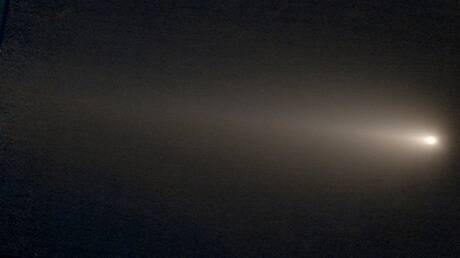
The Solar Astronomy Laboratory at the Russian Space Research Institute has announced the disappearance of comet C/2026 A1, which was considered the first comet to appear in the skies of 2026. This disappearance occurred after its close approach to the sun, resulting in a notable degradation of the comet.
Comet C/2026 A1 captured the attention of scientists and astronomy enthusiasts alike, as it was expected to provide unique observations. However, its proximity to the sun, known as the "solar approach" phenomenon, led to the erosion of its nucleus and the evaporation of its gases, resulting in its disappearance.
Details of the Disappearance
Astronomical phenomena such as the appearance of comets are rare events that attract the attention of both scientists and the public. Comet C/2026 A1, discovered earlier this year, was considered one of the most beautiful and brightest comets. However, its approach to the sun resulted in chemical interactions with the solar atmosphere, causing the comet to erode.
Studies show that comets are composed of ice and dust, and as they approach the sun, the heat begins to warm them, leading to the evaporation of their materials. This process, known as "sublimation," is the primary reason behind the disappearance of many comets.
Background & Context
Historically, comets were regarded as omens of doom in ancient cultures, often associated with catastrophic events. With the advancement of science, our understanding of these celestial bodies has become more precise. Comet C/2026 A1 is considered part of a family of comets that exhibit similar behaviors when approaching the sun.
The study of comets has evolved significantly, allowing scientists to gather insights into the early solar system and the processes that govern celestial mechanics. The disappearance of C/2026 A1 adds to the growing body of knowledge regarding cometary behavior.
Impact & Consequences
The disappearance of comet C/2026 A1 raises questions about how comets impact the space environment. Although this event may seem transient, it reflects the complex interactions between celestial bodies. Scientists continue to study the effects of these phenomena on planets and moons.
Understanding the dynamics of comets can provide valuable information about the formation of our solar system and the potential for future celestial events. The implications of such studies extend beyond mere observation, influencing our knowledge of planetary science.
Regional Significance
This event is particularly significant as it highlights the interactions between celestial bodies and how they affect the space environment. The increasing interest in astronomy in Arab countries is evident, with opportunities for scientific research expanding.
Moreover, the disappearance of C/2026 A1 serves as a reminder of the importance of education in the fields of science and technology, inspiring future generations to explore the wonders of the universe.