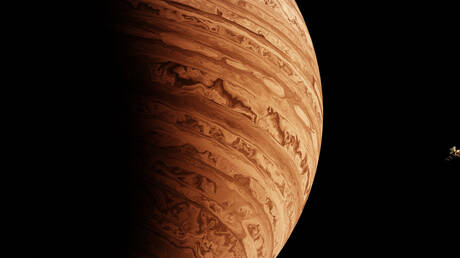
A recent scientific study has revealed that lightning strikes on Jupiter may be up to a hundred times stronger than those on Earth, potentially reaching a million times. These findings reflect the power of atmospheric phenomena on giant planets and raise questions about how these phenomena form in different environments.
Lightning strikes are fascinating natural phenomena that occur due to the discharge of electrical charges in the atmosphere. While Earth experiences strong lightning, Jupiter, the largest planet in the solar system, exhibits unprecedented strength in this phenomenon.
Details of the Event
Research has shown that Jupiter's lightning is not only more powerful but also more frequent. Strong lightning strikes have been observed that exceed the strength measured on Earth by several stages. These strikes produce immense energy, making them an important subject of study in astronomy.
This phenomenon is particularly present in the dense cloud regions of Jupiter, where various gases interact with each other, leading to the formation of strong electrical charges. Studies have indicated that these lightning strikes may have complex environmental effects on the planet.
Background & Context
Historically, Jupiter has attracted scientists' interest due to its large size and gaseous composition. Jupiter is rich in gases such as hydrogen and helium, making it an ideal environment for the formation of powerful atmospheric phenomena. Many studies have been conducted on Jupiter's atmosphere, but this recent study provides new insights into the strength of its lightning.
These findings are part of broader efforts to understand the giant planets in our solar system. With advancements in technology, scientists can study these planets more accurately, contributing to our expanding knowledge of the universe.
Impact & Consequences
These results open new avenues for understanding how atmospheric conditions affect other planets. They may also influence how we understand the processes of electrical charge discharge in the atmosphere, which could help develop better weather prediction models on Earth.
Moreover, these studies may enhance our understanding of atmospheric phenomena on other planets, which could assist in the search for life beyond Earth. Understanding how the atmospheres of giant planets work can provide clues about the potential for life in similar environments.
Regional Significance
Although this discovery pertains to a distant planet, it has indirect implications for the Arab region. Understanding atmospheric phenomena on other planets can enhance scientific research in weather and climate fields, which is crucial for many Arab countries facing increasing environmental challenges.
Additionally, this type of research can encourage the investment of more resources in science and technology, enhancing the ability of Arab countries to participate in global research and strengthening their position in the scientific community.
In conclusion, studying lightning strikes on Jupiter is not just a scientific discovery; it is a call to reflect on how natural phenomena influence our understanding of the universe and opens the door for further research that may change our perspective on other planets.