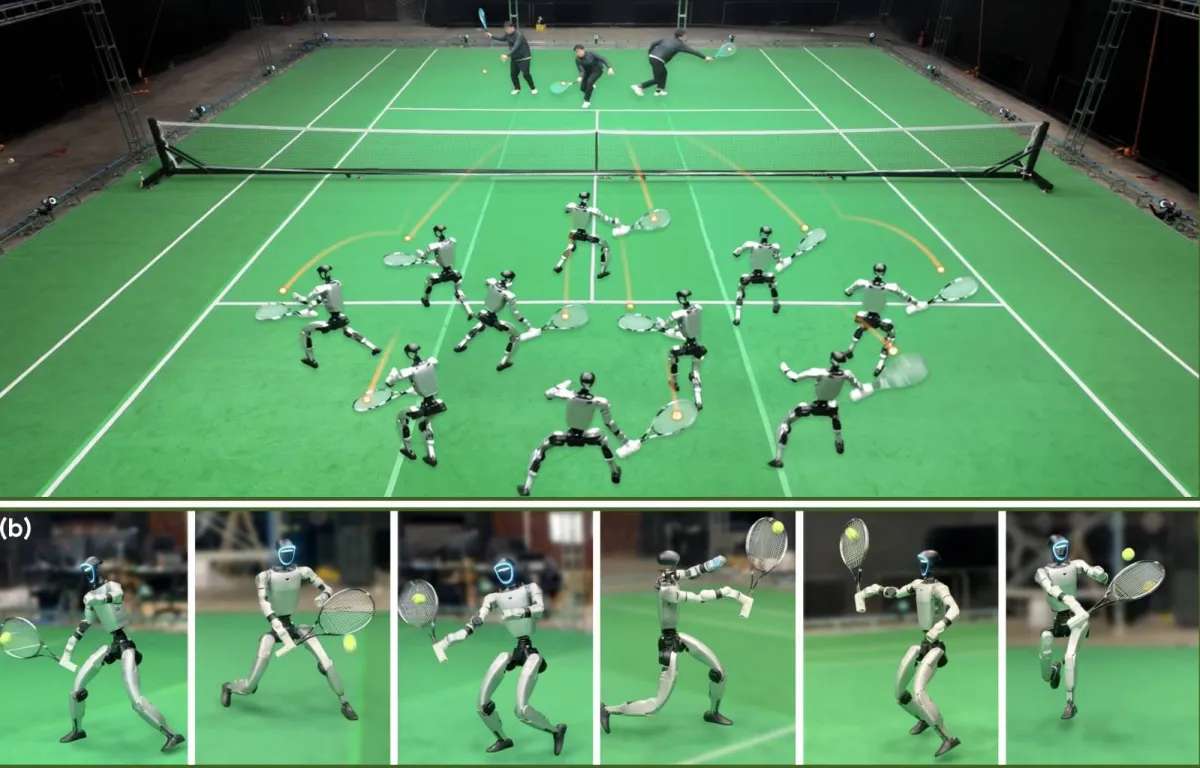
A recent study has demonstrated that robots are capable of learning complex motor skills, such as playing tennis, by utilizing incomplete data, representing a significant shift in artificial intelligence training methodologies. This research opens new avenues in how robots are taught, as reliance on perfect data is no longer a prerequisite.
In the realm of human-like robot development, teaching machines complex motor skills poses a significant challenge. Tasks that seem simple for humans, such as running, jumping, or even playing tennis, require precise coordination between balance, timing, and decision-making in fractions of a second. Automating the imitation of these capabilities traditionally required perfect data, which is difficult to obtain in reality.
Event Details
The study is based on the development of a model to teach a humanoid robot tennis skills, using inaccurate or incomplete human movement data. Instead of relying on complete recordings of movements, the system exploits partial segments of data and reconstructs them to build a cohesive motor behavior.
Traditionally, robotic motor learning systems depend on high-quality data captured using advanced motion tracking systems. This data provides an accurate description of each movement, but it is costly and difficult to scale, and it does not always reflect the complexities of the real world. In contrast, this research operates under the hypothesis that real-world data, even if incomplete, can be sufficient for teaching complex skills.
Background & Context
The proposed system divides the motion data into small segments, each representing part of a larger movement. It then links these segments together within a simulation environment, allowing the robot to learn how to transition smoothly from one movement to another. This approach somewhat resembles how humans learn a new skill, where partial experiences are combined to form a cohesive performance.
The researchers chose tennis as a testing environment due to its demands for coordination between movement and perception. Interacting with a moving ball requires estimating speed and direction, making an immediate decision on how to respond, and then executing the movement accurately. In experiments, the robot was able to learn how to hit the ball and interact with various situations, indicating that the model is not limited to repeating stored movements but develops a context-adaptive response.
Impact & Consequences
Transferring skills from simulation to reality represents one of the fundamental challenges. Researchers have worked to reduce this gap by designing the model to account for variability and inaccuracies in the data, making it more adaptable in practical applications. The significance of this research lies not in the robot's ability to play tennis per se, but in what it indicates about a broader shift in learning methodologies.
If systems can be trained on complex skills using imperfect data, it opens the door to utilizing more diverse data sources, such as public videos or unstructured recordings. This, in turn, could accelerate the development of what is known as 'embodied artificial intelligence,' where systems interact directly with the physical world.
Regional Significance
This study represents an important step towards enhancing the use of artificial intelligence in various fields, including education and sports training. This technology could contribute to developing new training programs for athletes, enhancing their capabilities and increasing their chances of success in competitions.
In conclusion, this research serves as evidence that the path to teaching robots may not require perfection but rather the ability to leverage deficiencies. This trend suggests a rethinking of the relationship between data and learning, which could change the way robots are developed in the future.