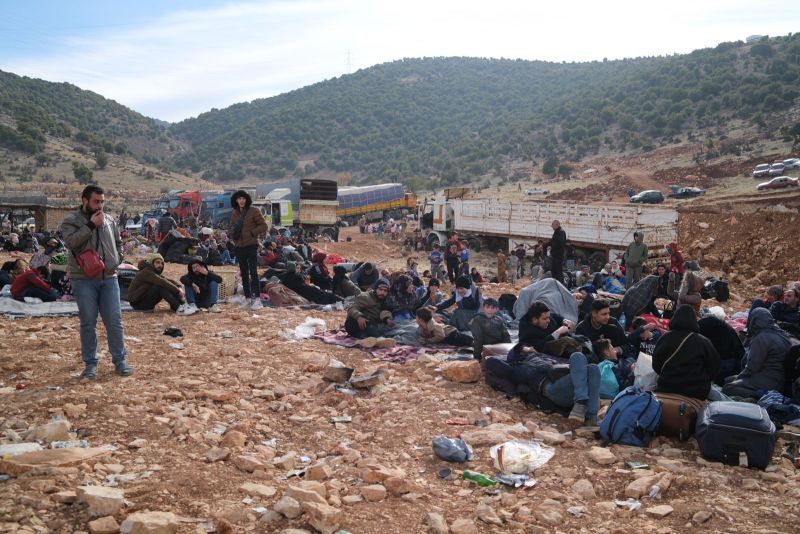
The Syrian government announced the temporary closure of the Jdeidet Yabous-Masnaa border crossing with Lebanon as a precautionary measure following warnings from the Israeli army about potential airstrikes on the crossing. The Israeli military has alleged that the crossing is used by Hezbollah to smuggle weaponry, a claim that Damascus has vehemently denied, asserting that the crossing is exclusively for civilian passage and is not used for any military purposes.
This development comes amid increasing security tensions in the region, with rising fears of escalating hostilities between Israel and Hezbollah. The Israeli warnings have raised concerns among political and public circles in Syria, where the government views these threats as attempts to destabilize the country.
Details of the Incident
Local sources reported that the closure of the crossing followed a series of Israeli warnings claiming that Hezbollah uses the crossing for smuggling arms and military equipment. Damascus emphasized that the crossing is solely for civilian transit, and any claims to the contrary are mere fabrications aimed at justifying Israeli aggression.
On the other hand, Syrian authorities confirmed they would work to secure the borders and prevent any attempts at weapon smuggling, stressing the importance of ensuring civilian safety. The Syrian-Lebanese border has witnessed numerous security incidents in recent years, complicating the situation in the region.
Background & Context
Historically, the border between Syria and Lebanon has seen ongoing tensions, particularly with the presence of Hezbollah, which is considered one of the most prominent armed factions in the region. This group has played a pivotal role in the Syrian conflict, making it a constant target of Israeli threats. Relations between Damascus and Tel Aviv remain strained, with both countries exchanging accusations regarding military and security activities along the border.
In recent years, Israel has intensified its airstrikes on Syrian territory, targeting what it describes as military sites belonging to Hezbollah. This escalation is seen as part of a broader Israeli strategy aimed at preventing the enhancement of Hezbollah's military capabilities in the region.
Impact & Consequences
The closure of the crossing could exacerbate humanitarian conditions in the area, as many civilians rely on this crossing for trade or medical purposes. Additionally, the ongoing military tensions may negatively impact reconstruction efforts in Syria, which has been suffering from the effects of a civil war lasting over a decade.
Moreover, any military escalation could drag the region into a wider conflict, increasing civilian suffering and affecting regional stability. Hezbollah is considered part of the resistance axis that includes Iran and Syria, making any military escalation with Israel have implications at the regional level.
Regional Significance
These developments indicate the persistence of tensions in the Middle East, where political and military interests intersect. The closure of the crossing illustrates that humanitarian and political crises in the region remain unresolved, and peaceful solutions are still far from reach.
Under these circumstances, hope rests on the international community's efforts to find peaceful solutions that ensure regional stability and alleviate civilian suffering. Recent events highlight the urgent need for dialogue and understanding among the involved parties to avoid further escalation and humanitarian tragedies.