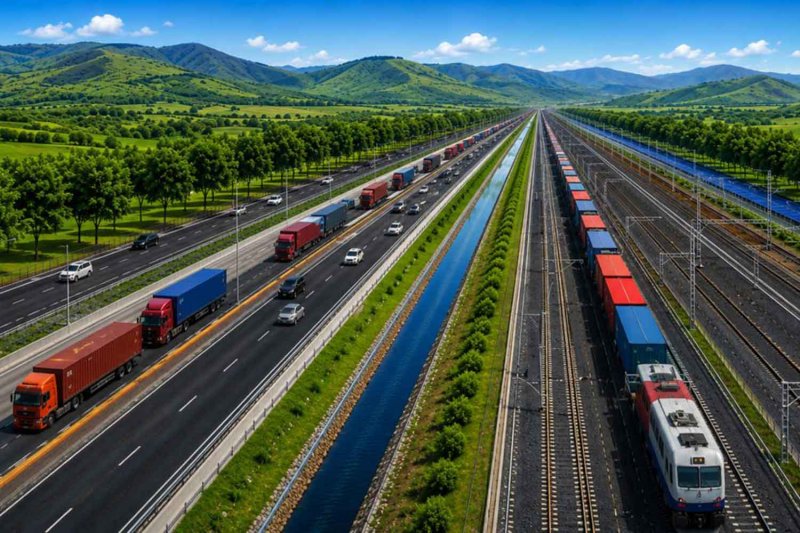
The land bridge project in Thailand, promoted under the government of the Phuea Thai Party led by former Prime Minister Yingluck Shinawatra, is seen as a bold geopolitical vision aimed at enhancing the national economy and helping the country escape the middle-income trap. The project seeks to create a shortcut linking the Indian and Pacific Oceans, reducing reliance on the Strait of Malacca and repositioning Thailand as a key hub in global trade routes.
With the Palang Pracharath Party government, led by Anutin Charnvirakul, pushing the project more vigorously, questions have begun to arise regarding the feasibility of achieving the promised economic transformation, especially amid concerns over potential social and environmental impacts.
Project Details and Logistics
The government claims that the project could reduce shipping times by up to four days, potentially reshaping Thailand as a regional center for maritime trade and logistics. The concept is straightforward: instead of sailing around the Malay Peninsula, containers would be unloaded at a deep-water port on the Andaman coast, then transported across Thailand via rail and road, and reloaded onto ships on the Gulf of Thailand side.
However, in reality, maritime logistics are not determined solely by distance. Each additional transfer point incurs hidden costs and delays. Ships using the land bridge will need to wait to reach the dock, unload containers, and navigate customs and logistics systems, which may take longer than anticipated.
Background & Context
Historically, Thailand has relied on the Strait of Malacca as a primary route for maritime trade. However, increasing challenges, including congestion and environmental concerns, have prompted the government to consider alternatives. The land bridge project is part of a broader vision to develop the Southern Economic Corridor, aimed at attracting industrial investments and improving infrastructure.
Similar experiences in other countries, such as the Eastern Economic Corridor in Thailand, show that success depends on having an established industrial system. While the Eastern Corridor benefits from industrial density and supplier networks, the South still needs to develop this system.
Impact & Consequences
Concerns are rising that the project could turn into a real estate venture rather than a genuine industrial transformation, potentially leading to the creation of unused industrial zones. Without strong investments and long-term demand, these areas could become mere undeveloped lands instead of productive economic clusters.
Furthermore, public acceptance and social legitimacy may play a crucial role in the project's fate. Historically, Thailand has faced resistance to large industrial projects, with local communities rejecting environmental and economic risks that could threaten their livelihoods.
Regional Significance
The land bridge project is a strategic step towards developing the Thai economy, but it faces challenges that could impact its success. The balance between economic ambitions and social realities will be essential in determining whether this project can fulfill its potential.
In conclusion, while the land bridge project offers significant opportunities for Thailand, its success will depend on addressing logistical challenges and gaining public support to ensure that it contributes positively to the economy and society.