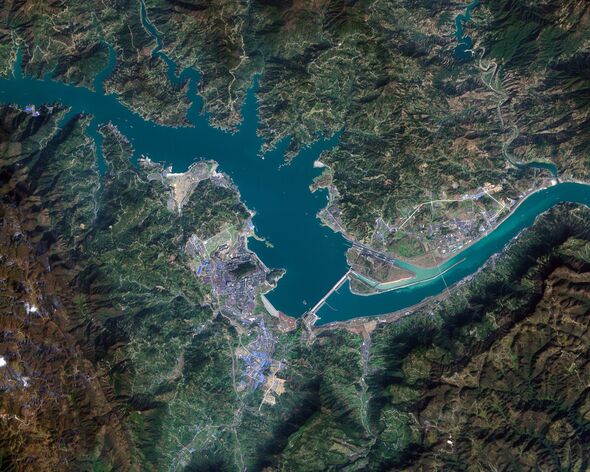
NASA scientists have revealed that the Three Gorges Dam in China, which holds around 40 cubic kilometers of water, can affect the rotation of the Earth. Although the impact is considered minimal, this engineering achievement highlights the power of modern engineering on a cosmic scale.
The Three Gorges Dam, completed in 2012, is located on the Yangtze River, stretching over 2,300 meters in length and standing at a height of 185 meters. The dam retains an enormous volume of water equivalent to 10 trillion gallons, situated at an elevation of 175 meters above sea level. This elevation and mass distribution can lead to a slight change in the rotation of the Earth.
Event Details
In a study conducted by scientists Benjamin Fong Chao and Richard Gross from NASA, the impact of the 2004 Indian Ocean earthquake on Earth's rotation was analyzed. The results indicated that the earthquake shortened the day by 2.68 microseconds and shifted the North Pole eastward by 2.5 centimeters.
When applying the same calculations to the Three Gorges Dam, it was found that filling the dam's reservoir would extend the day by only 0.06 microseconds, with the pole moving by 2 centimeters. Additionally, it would make the Earth slightly more spherical in the middle and flatten its surfaces at the poles.
Background & Context
Modern engineering is capable of impacting the Earth in unexpected ways. For instance, the Moon affects Earth's rotation significantly, slowing it down by 1.7 milliseconds per century, which is 17,000 times greater than the effect of the Three Gorges Dam. Moreover, earthquakes, groundwater extraction, and the melting of glaciers in Greenland and Antarctica all influence mass distribution on Earth, measurably slowing its rotation.
These changes require scientists to consider the possibility of adding a negative second in the future to synchronize time with these changes.
Impact & Consequences
Although the actual impact of the Three Gorges Dam on Earth's rotation is considered marginal, the dam's primary benefits include energy generation, flood control, and environmental transformations. Research indicates that any movement of mass, from earthquakes to weather, has an effect, and modern engineering now operates on cosmic scales that physicists must take into account.
These findings serve as evidence that large engineering projects can affect the Earth in unexpected ways, opening the door for further research and studies in this field.
Regional Significance
While this news pertains to a dam in China, the impacts of modern engineering on the environment and Earth's rotation may have global ramifications. In the Arab region, major projects could contribute to better management of water and energy resources, enhancing environmental sustainability.
Ultimately, this research underscores the importance of understanding the impacts of large engineering projects on the Earth, emphasizing the need for continued studies in this area to ensure environmental sustainability.