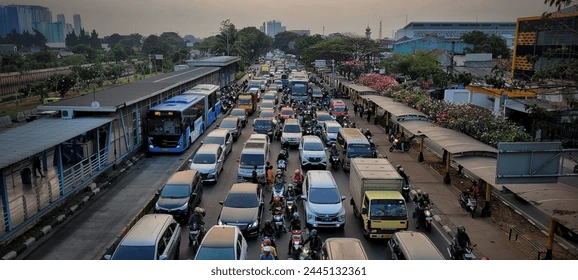
Jakarta's eastern streets, particularly on Basuki Rahmat Street, have experienced a resurgence of traffic congestion following the Eid al-Fitr holiday, leading to long queues of cars and motorcycles. Many drivers, such as Hasan and Kevin, indicated that they expected this situation and left early to avoid the traffic.
On Monday morning, the first working day after the holiday, vehicles piled up on several main streets, resulting in slow traffic. Hasan, who works in the Mega Kuningan area, confirmed that he had to face the congestion despite trying to leave his home early.
Details of the Event
Reports indicate that traffic was heavy on Basuki Rahmat Street, where many drivers were heading to work or dropping their children off at school. Kevin, one of the drivers, noted that daily activities resumed fully after the holiday, increasing pressure on the roads.
There are growing calls from citizens for the government to take effective measures to alleviate congestion, especially with the increasing number of vehicles coming from the Bekasi area to Jakarta. This route is considered one of the most important corridors used by employees to reach their workplaces in the capital.
Background & Context
Jakarta is one of the most congested cities in the world, where its residents face daily challenges due to traffic. Historically, the city has seen numerous projects aimed at improving infrastructure, but the continuous increase in population and vehicles has made it difficult to control congestion.
After every long holiday, the city returns to its normal state, leading to increased traffic congestion. This situation requires the government to consider long-term solutions, such as improving public transportation and expanding roads.
Impact & Consequences
The state of traffic congestion affects the daily productivity of employees, as many spend longer commuting times. This can lead to decreased job performance and increased stress levels among drivers.
Moreover, congestion negatively impacts the environment, as carbon emissions rise due to traffic jams. Therefore, it is essential for the government to adopt effective strategies to mitigate this phenomenon.
Regional Significance
Traffic congestion is a common issue in many major cities in the Arab world, such as Cairo and Beirut. The conditions in these cities are similar to what is happening in Jakarta, necessitating the exchange of experiences and solutions between countries.
Arab cities could benefit from international experiences in traffic management, such as improving public transportation and developing infrastructure. Cooperation among countries in this field may contribute to enhancing the quality of life for citizens.