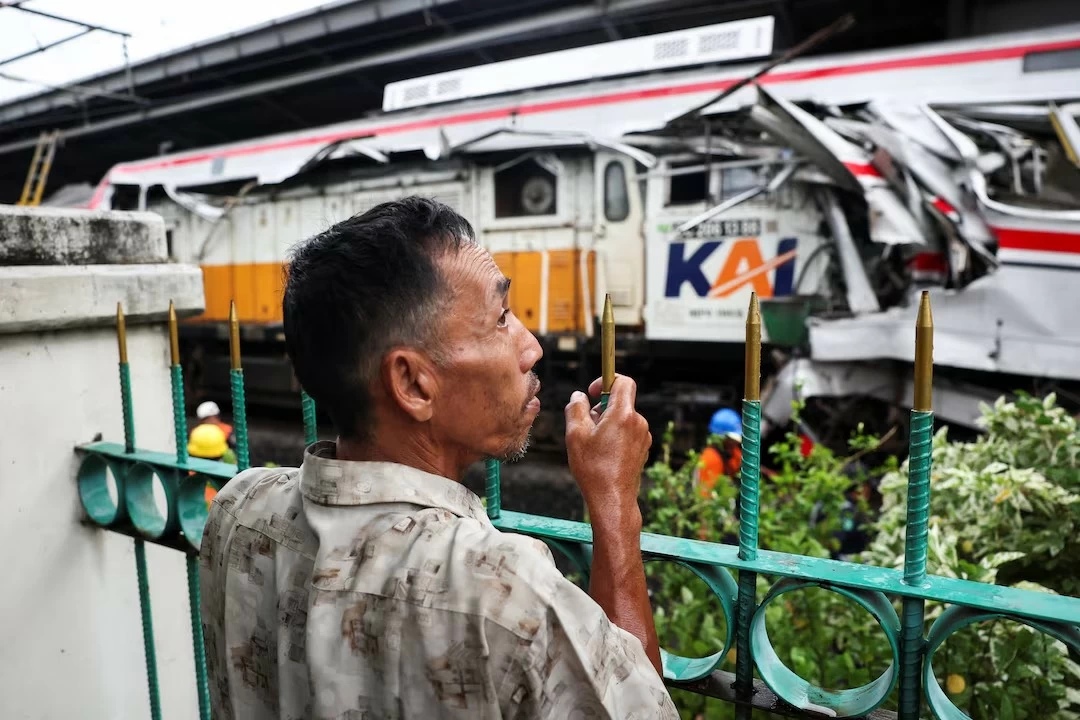
A train collision near Indonesia's capital Jakarta resulted in the deaths of 14 people and injuries to 84 others, according to the state railway company. The incident occurred last night (Monday) in the Bekasi area, east of Jakarta, where a local passenger train collided with another train operating on long distances.
The executive director of the Indonesian state railway company, Budi Rasidin, confirmed that the number of victims has risen to 14 fatalities. The head of the search and rescue agency, Muhammad Shafii, explained that evacuation operations were completed after complex efforts to extract trapped passengers from the damaged carriages.
Details of the Incident
Shafii noted that rescue teams had to use specialized equipment and trained personnel to carefully handle the debris, confirming that there were no more missing passengers, while search operations continued in anticipation of finding human remains. One of the train cars designated for women was the most affected, as all the victims were women, most of whom were trapped under collapsed metal structures.
During the rescue operations, teams used cutting tools to reach survivors before separating the two trains. In detailing the incident, Rasidin explained that the passenger train first collided with a taxi on the tracks before being struck by the approaching long-distance train.
The Vietnamese electric taxi company Green SM Indonesia confirmed that the involved vehicle belongs to its fleet, indicating its cooperation with authorities in the ongoing investigations.
Background & Context
In a related context, Indonesian President Prabowo Subianto ordered a comprehensive investigation into the incident following his visit to the injured at a Bekasi hospital. He also announced a plan to construct an overpass near the accident site to reduce traffic congestion, criticizing the poor maintenance of parts of the railway network.
The National Transportation Safety Committee of Indonesia is investigating the circumstances of the accident, as families flocked to the train station searching for their loved ones. In an emotional testimony, one passenger, Hiryati, stated that she intended to board the women's carriage but changed her mind at the last moment, adding that she was on the phone with her husband at the moment of the collision.
Impact & Consequences
Suburban trains in Jakarta are among the most crowded in the world, and the incident disrupted several services. Road transport accidents are relatively common in Indonesia, which experienced a similar train collision in 2024 in West Java that resulted in casualties and injuries.
Concerns about transportation safety in Indonesia are increasing, as significant improvements in railway infrastructure and the implementation of higher safety standards are required.
Regional Significance
This incident highlights the importance of improving transportation systems in developing countries, including Arab nations. Similar accidents serve as a crucial reminder of the need to enhance safety standards in public transport.
In conclusion, the tragic accident reflects the significant challenges facing transportation systems in Indonesia and should serve as a catalyst for improving safety and preventing such disasters in the future.