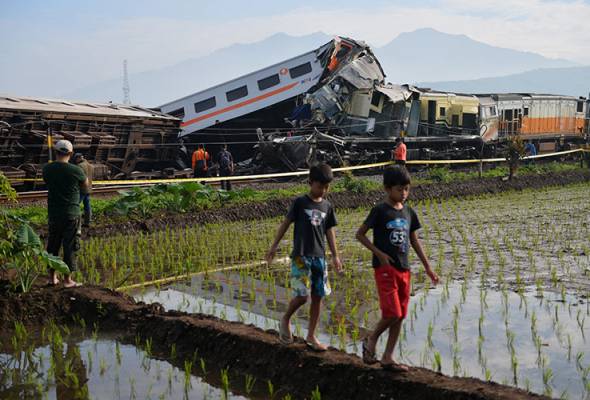
A collision between two trains occurred near the capital of Indonesia, Jakarta, resulting in the deaths of 14 people and injuring 84 others, as reported by the state railway company on Tuesday. The incident took place last night when a long-distance train collided with the last carriage of a commuter train near the Bekasi Timur station, which is located approximately 25 kilometers from the capital.
Local police reported that rescue teams managed to separate the two trains, using tools to cut through the metal of the carriages to reach survivors. A witness quoted by Reuters described the scene as horrific, noting that many of the injured were in critical condition.
Details of the Incident
Earlier this morning, Anna Borba, the spokesperson for the train operating company in Indonesia, reported that the accident resulted in the deaths of 7 people and injuries to 81, but the numbers later increased as rescue operations continued. The National Transportation Safety Committee of Indonesia announced the opening of a comprehensive investigation into the incident, and several passenger train services were canceled as a result of the accident.
Local commuter trains are among the most crowded modes of transport in Jakarta, a city classified as one of the most densely populated in the world. Transportation accidents in Indonesia are not new, as the country has experienced similar incidents in the past, raising questions about safety standards in public transport.
Background & Context
Indonesia, one of the largest countries in Southeast Asia, faces significant challenges in transportation. Despite efforts to improve infrastructure, railway accidents remain common. In 2024, West Java province witnessed another collision that resulted in the deaths of 4 people and injuries to dozens, highlighting the urgent need for improved safety standards.
Historically, Indonesia has struggled with weak transportation systems, leading to tragic accidents. As the population grows, there is an increasing need to enhance public services and provide safe and efficient transport options.
Impact & Consequences
This incident underscores the necessity of reviewing safety policies in Indonesia's transportation sector. The investigation launched by the National Transportation Safety Committee is expected to yield recommendations that could contribute to improving safety standards, potentially reducing similar accidents in the future.
This accident may also affect public confidence in public transport, prompting citizens to seek alternative means of transportation, which could increase traffic congestion in the city.
Regional Significance
Although the accident occurred in Indonesia, transportation accidents remain a concern for all countries, including Arab nations. The challenges related to safety in public transport require special attention from governments, especially in light of population growth and urban expansion.
Arab countries can learn from Indonesia's experiences in improving safety standards, as developing public transportation systems is vital to ensuring the safety of citizens.