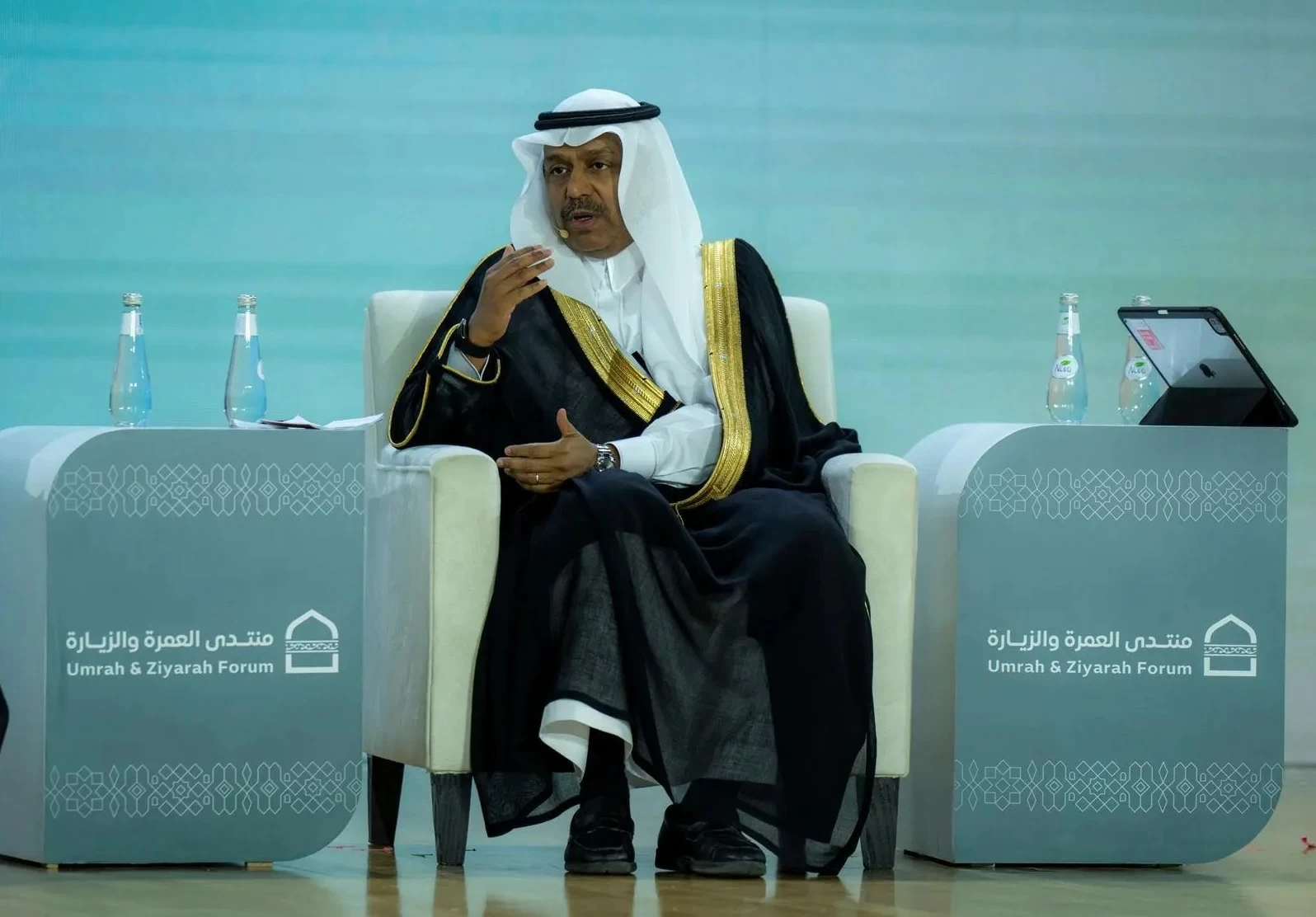
The Deputy Minister of Hajj and Umrah, Dr. Abdul Fattah bin Suleiman Mashat, confirmed that the Umrah and visit system is undergoing a radical transformation at all stages of the spiritual journey for the guests of Allah, starting from the planning phase before arriving in the Kingdom, all the way to their departure back to their home countries.
This was stated during a panel discussion held today, titled "The Kingdom's Integrated Model for Serving the Guests of Allah in Light of Vision 2030," as part of the third edition of the Umrah and Visit Forum. The session featured the participation of Dr. Abdul Fattah bin Suleiman Mashat, the Deputy Minister of Hajj and Umrah, Abdulaziz bin Abdullah Al-Duailej, the President of the General Authority of Civil Aviation, and Eng. Muhammad Abu Al-Khair Ismail, the CEO of the Guests of Allah Service Program, while the session was moderated by Eng. Abdul Mohsen Al-Salem, the Undersecretary of the Ministry of Hajj and Umrah for Umrah Affairs.
Event Details
During the session, the Deputy Minister of Hajj and Umrah emphasized the launch of developmental initiatives and the organization of relationships with Umrah companies, which contribute to enhancing the quality of services in the Umrah and visit system. This improvement will reflect positively on the experience of the guests of Allah and convey the Kingdom's message to the world.
He explained that the journey of the guest of Allah begins today with an idea and ends with an impact, achieving sustainability and growth for services, under the exceptional care and great attention from the wise leadership towards the Two Holy Mosques and their visitors, in accordance with the objectives of Vision 2030.
Background & Context
He highlighted the comprehensive digital transformation through the "Nusk" system, which has contributed to expanding the scope of services and increasing the number of beneficiaries. The number of users of the "Nusk" application has exceeded 51 million users worldwide, providing comprehensive services that cover various details of the spiritual and enriching journey for pilgrims and visitors.
Regarding current events, he clarified that the ministry adopts proactive plans to manage challenges, based on cumulative experiences and real-life trials, along with comprehensive solutions in serving the guests of Allah. He pointed out that work in the Umrah and visit system has shifted from mere coordination between entities to integration and teamwork, enhancing the quality of services provided with ease and convenience.
Impact & Consequences
He added that success metrics are no longer measured by numbers alone but also include showcasing the stories of the guests of Allah and highlighting their experiences. For his part, Abdulaziz bin Abdullah Al-Duailej, the President of the General Authority of Civil Aviation, confirmed that the Guests of Allah Service Program represents an advanced model for the integration of entities, including the aviation system. He noted that the number of flights to Jeddah and Medina airports is expected to double by 2025, reflecting the accelerated growth in Umrah and visit activities.
He explained that the guest of Allah interacts with more than 20 entities upon arriving at the airport, all of which work harmoniously to serve him. He pointed out that the Kingdom's airports have achieved advanced global rankings, continuing to develop terminals and increase capacity, alongside successfully managing challenges and facilitating air traffic despite regional conditions, and opening additional outlets to accommodate movement and ease the departure of stranded individuals from various countries.
Regional Significance
For his part, Eng. Muhammad Abu Al-Khair Ismail, the CEO of the Guests of Allah Service Program, stated that the satisfaction rate of the guests of Allah has exceeded the targets of Vision 2030, emphasizing that understanding the guest's journey in all its details is fundamental to improving the experience. He noted that more than 60 governmental entities and partners from the private sector are working within an integrated system, and measuring guest satisfaction has become an intrinsic part of the work culture, highlighting that Mecca and Medina represent a unique civilizational narrative that is being showcased through the development of historical sites and enriching destinations.
The panel discussions at the third edition of the Umrah and Visit Forum embody comprehensive knowledge platforms, bringing together decision-makers and experts to showcase best practices and exchange experiences, contributing to the development of services, innovation of solutions, and enhancing integration among entities, thereby elevating the experience of the guests of Allah in line with the objectives of Vision 2030.