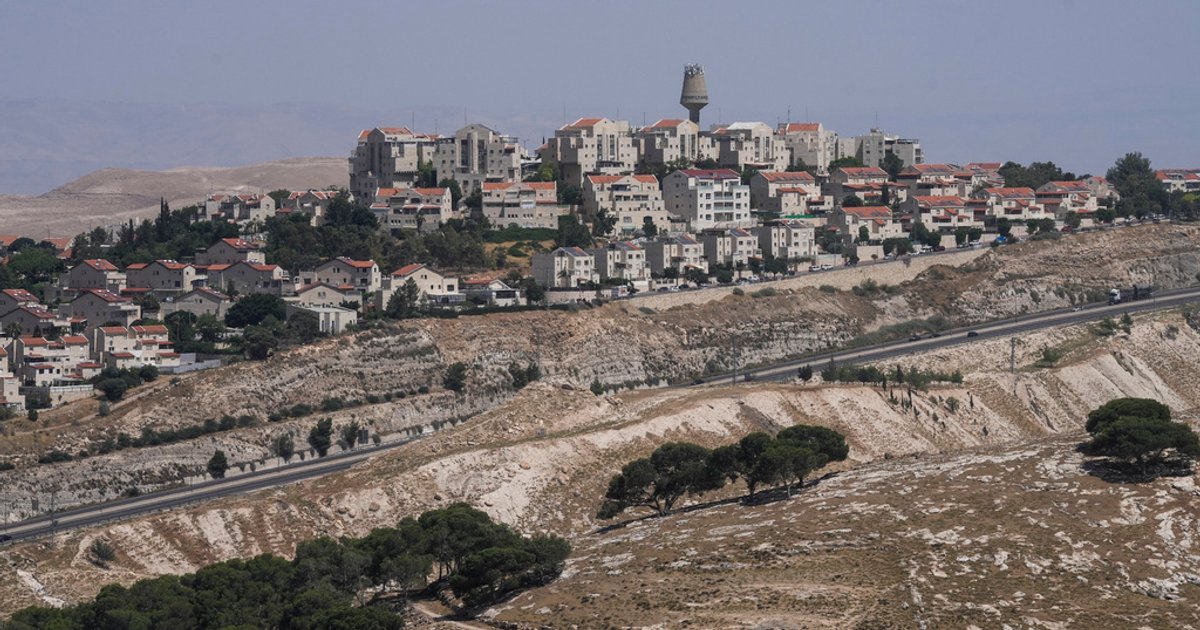
The West Bank has turned into an isolated archipelago over the past six decades due to Israeli settlement, where the map of the region is no longer just a disputed political boundary but embodies a complex process of "spatial engineering" that reshapes Palestinian geography.
The Israeli project has not been limited to building housing units for settlers but has aimed at dismantling the Palestinian geographical fabric and replacing it with a connected Israeli control network. Today, in the year 2026, the term "settlement expansion" is no longer sufficient to describe the scene; we are faced with a reality of "spatial resolution," where Palestinian geography has become an "archipelago" of isolated islands within a space of comprehensive Israeli control.
Details of the Event
The settlement of Ma'ale Adumim, one of the largest settlements in the West Bank, is located 7 kilometers east of Jerusalem. Established in 1975 on land confiscated from Al-Eizariya, Abu Dis, and Al-Tur, it is considered part of the (E-1) project, which aims to connect it to Jerusalem through continuous settlement expansion, effectively isolating Jerusalem from its Palestinian surroundings.
Field data indicates that more than 780,000 settlers reside in the West Bank, including East Jerusalem, distributed across 192 official settlements and over 350 outposts. This spread is no longer random but follows a strategy of "pivot points" aimed at cutting communication between major Palestinian cities.
Background & Context
Israel effectively controls about 42% of the West Bank area through settlements and its affiliated regional councils. Areas classified as (C) under the Oslo Accords constitute about 61% of the total area and have become a strategic reservoir for settlement, where Palestinians are prohibited from building in 99% of it, while settlers are granted extensive facilitation.
In the last three years, especially since October 2023, the West Bank has witnessed a phase of "rush towards annexation," where Israel has shifted from a pattern of official government settlement to a pattern of "field privatization," leading to an increase in pastoral outposts controlling thousands of dunams.
Impact & Consequences
Bypass roads contribute to the fragmentation of the West Bank, consuming about 3% of the area, but their impact goes far beyond that, as they create a sharp spatial separation that prevents the natural expansion of Palestinians. Moreover, settler violence has ceased to be an individual behavior; it has transformed into a functional tool within the policy of land emptying, resulting in the displacement of many Palestinian communities.
In 2025 alone, 991 demolition orders were issued, and 1,400 facilities were destroyed, reflecting a systematic policy of constraining the elements of Palestinian life. At the same time, 925 closure points are spread throughout the West Bank, making Palestinian movement a complex process.
Regional Significance
On the 50th anniversary of Land Day, data indicates that the conflict is no longer confined to negotiable political boundaries but has become a struggle for physical existence on the land. Israeli policies are not limited to control but extend to redesigning geography in a way that prevents the emergence of a connected Palestinian entity.
The "engineering of fragmentation" is becoming a tool for rewriting reality, where national rights become a humanitarian issue within isolated islands in an expanding settlement environment. This reality imposes new challenges on Palestinians and affects stability throughout the entire region.