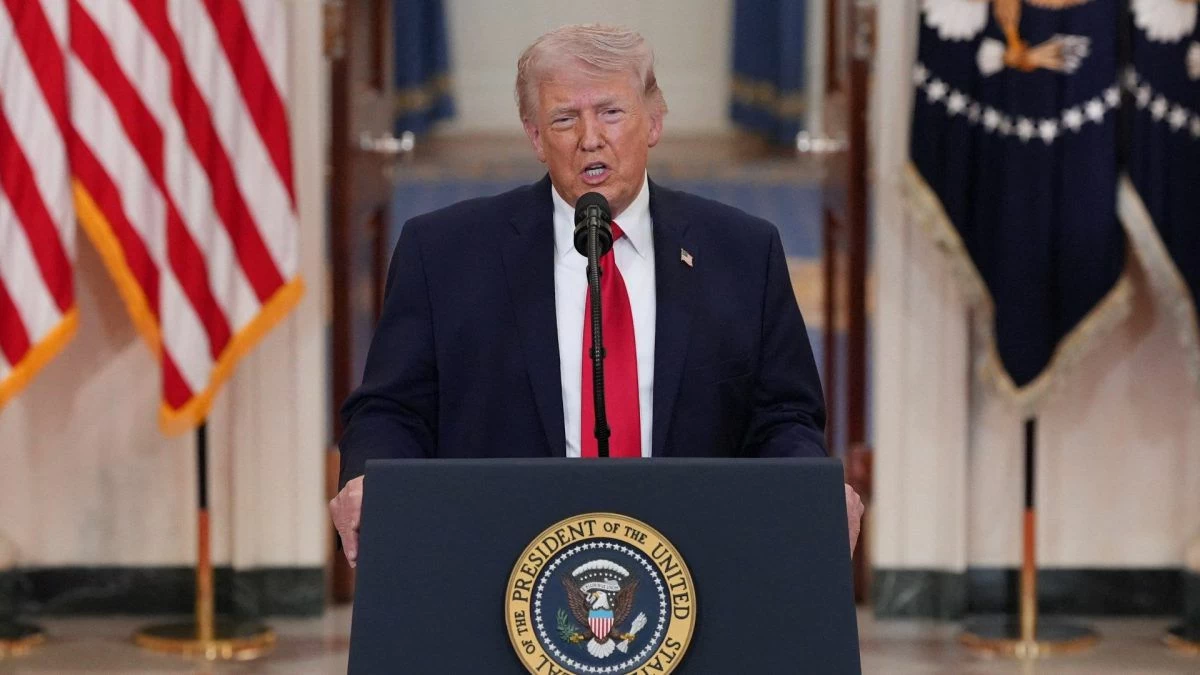
In a confrontational speech filled with decisive messages, U.S. President Donald Trump announced what he described as a 'major victory' in the confrontation with Iran, asserting that Tehran's military and nuclear capabilities have suffered significant blows. Trump stated that his country is steadily moving towards completing its mission, saying: 'We will not allow any harm to come to the Gulf states,' while hinting at further strikes and emphasizing the need to prevent Iran from acquiring nuclear weapons 'forever.'
Trump pointed out that U.S. forces have 'stunningly' eliminated Iran's military capabilities, explaining that there has been widespread destruction of missile launch platforms and drones, and that the Iranian naval forces have 'completely ended,' while the air force is in a 'state of total destruction.' He added that recent operations have resulted in the deaths of 'most of the regime's leaders.'
Details of the Event
The U.S. President stressed that Iran 'will never obtain nuclear weapons,' revealing that attempts to rebuild the nuclear program at secret sites have been monitored. He affirmed that his administration has 'corrected the mistakes of previous administrations' by terminating the nuclear deal, announcing the 'eradication of Iranian nuclear capabilities.'
Trump clarified that U.S. forces have achieved 'swift and decisive victories' over the past weeks, asserting that the strategic objectives of the war are 'close to being realized,' and that the U.S. is 'on the right track to complete all its military goals,' with the 'end of the mission in Iran' approaching.
Background & Context
Trump's statements come at a sensitive time, as tensions between the United States and Iran escalate following years of the nuclear deal reached in 2015. This agreement aimed to reduce the Iranian nuclear threat in exchange for easing sanctions, but the U.S. withdrawal in 2018 led to a significant escalation of tensions.
Historically, Iran has been a focal point of U.S. policy in the Middle East, with Washington viewing it as a threat to regional security. This situation has led to multiple U.S. military interventions in the region, affecting relations between Arab countries and the United States.
Impact & Consequences
Analysts expect that U.S. statements will escalate tensions in the region, as Iran may take retaliatory steps or increase its military activities. Additionally, the growing pressures on Iran could exacerbate humanitarian and economic conditions within the country.
On the other hand, these statements may influence oil prices and global markets, especially if Trump’s threats to target Iranian oil facilities are carried out. The stability of the Gulf states heavily depends on how these situations develop.
Regional Significance
For Arabs, these statements carry significant implications, as many Gulf countries are concerned about any escalation that may affect their security. These conditions could lead to strengthened alliances between Gulf states and the United States in an attempt to counter Iranian threats.
In conclusion, it seems that the situation in the region will remain tense, with the United States continuing its confrontational policy towards Iran, placing Gulf states in a sensitive position that requires them to take strategic steps to ensure their security and stability.