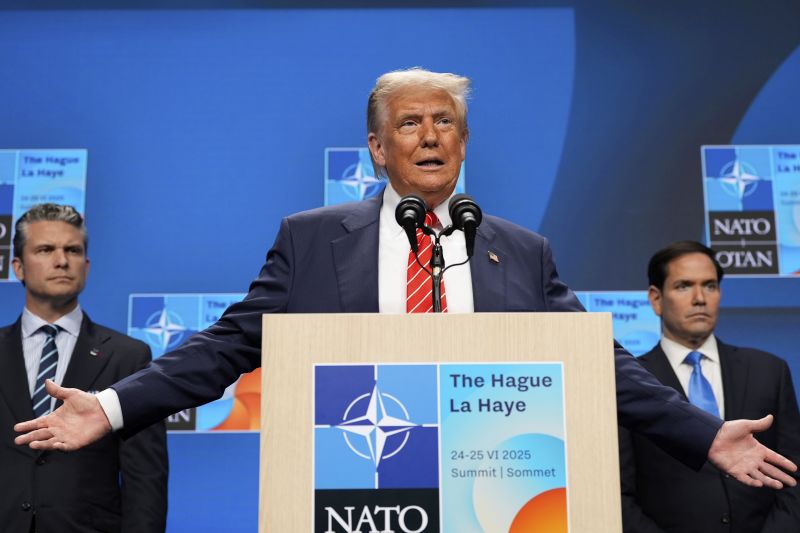
U.S. President Donald Trump sparked widespread controversy on Friday when he declared that the United States "is not obligated to stand by NATO (North Atlantic Treaty Organization)." These comments come at a time when the historic military alliance faces significant challenges, raising questions about Washington's commitment to the collective defense provisions that form the core of this alliance.
Trump's remarks align with his foreign policy focus on "America First," as he seeks to reassess U.S. commitments to traditional allies. This statement has raised concerns among many NATO member countries that rely on U.S. military support in the face of security threats, particularly from Russia.
Details of the Event
During a press conference, Trump emphasized that the United States is not obligated to defend NATO member states if those countries do not commit to increasing their defense budgets. He pointed out that some member nations fail to meet their financial obligations, making it unreasonable for the U.S. to remain committed to defending them. These comments come after a period of tensions between the United States and its NATO allies, especially following the escalation of Russian threats in Eastern Europe.
It is worth noting that NATO is a military alliance established in 1949, comprising 30 countries, and relies on the principle of collective defense, where any attack on one member is considered an attack on all. However, Trump's remarks could undermine this principle, raising fears that it could lead to the disintegration of the alliance or increased tensions in the region.
Context and Background
Since taking office, Trump has taken controversial stances towards traditional U.S. allies, repeatedly criticizing European countries for not spending enough on defense. He has indicated that the United States bears the largest burden of NATO costs, which undermines its strategic position. These statements are not new; Trump has previously threatened to withdraw U.S. troops from Europe if member states do not commit to increasing their defense budgets.
In recent years, relations between NATO and Russia have seen increasing tension, especially following Russia's annexation of Crimea in 2014. This has led to a bolstered NATO presence in Eastern Europe, escalating tensions between the two sides. In this context, Trump's statements are seen as a call to reconsider U.S. defense strategy towards Europe.
Consequences and Impact
Trump's remarks could have serious implications for European security, as NATO member states may feel insecure if the United States decides to reduce its commitments. This situation could prompt some countries to enhance their military capabilities individually, potentially leading to a new arms race in the region.
Furthermore, these statements may encourage Russia to take more aggressive steps in the area, interpreting them as a sign of weakness in U.S. commitment to defending its allies. This could escalate tensions in Eastern Europe and increase the risk of military conflicts.
Impact on the Arab Region
Although Trump's remarks pertain to NATO, they have indirect effects on the Arab region. Tensions in Europe could impact regional stability, especially amid ongoing crises in the Middle East. Additionally, a weakened U.S. commitment to its allies may reflect on its support for Arab countries facing security challenges.
At the same time, some regional powers, such as Iran, may exploit this opportunity to enhance their influence in the area, complicating the security landscape further. Consequently, Trump's statements could open the door to increased tensions in the Arab region, where Arab states need to reassess their security strategies in light of changing U.S. policies.
In conclusion, Trump's statements regarding NATO remain a contentious topic, raising questions about the future of military alliances worldwide. As international tensions continue, the question remains: how will these remarks affect security and stability globally?