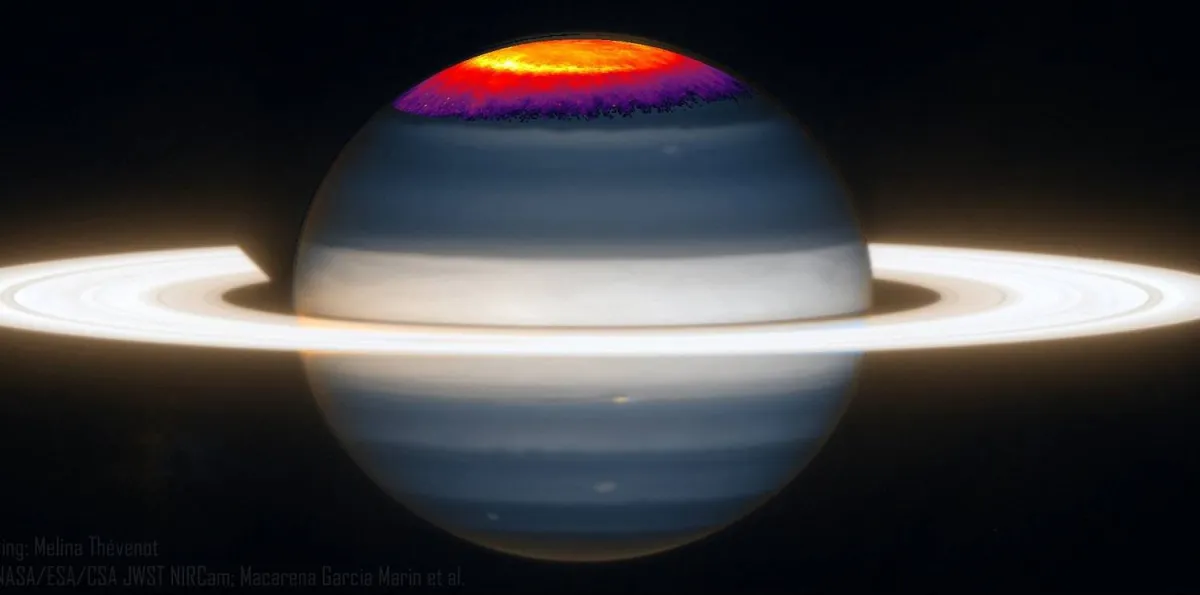
Researchers from Northumbria University in the UK have revealed the secret behind one of the oldest mysteries in planetary science, concerning the changing rotation speed of Saturn. The new study, published in the "Journal of Geophysical Research: Space Physics," discovered complex patterns of heat and charged particles in Saturn's auroras.
Saturn has long puzzled scientists, especially after measurements taken by NASA's Cassini spacecraft in 2004 showed that the planet's rotation rate changes over time. This was scientifically perplexing, as it was not expected for a planet to alter its speed in such a manner.
Details of the Discovery
In 2021, a team led by astronomer Tom Stallard from the University of Leicester found that the apparent change in rotation speed is not related to Saturn's own rotation but is caused by winds in its upper atmosphere. These winds generate electric currents that provide misleading signals in the auroras. However, the most crucial question remained: what causes these winds?
During the new study, researchers utilized the James Webb Space Telescope to continuously observe Saturn's northern auroras over a full day. By analyzing the infrared radiation emitted by a molecule known as "tritium," the team was able to produce the first high-resolution maps of temperature and particle density in this region.
These measurements exhibited unprecedented accuracy, being ten times more precise than previous measurements, allowing for the observation of fine details in the heating and cooling processes within the atmosphere.
Background & Context
The results showed that the patterns of heat and density closely match predictions from older computational models, provided that the source of heat is in the same areas where the auroras enter the atmosphere. This means that the auroras on Saturn are not merely a beautiful light display but actively contribute to heating the atmosphere in specific regions.
This heating generates winds, which in turn produce electric currents that feed back into the auroras, creating a self-sustaining cycle. The team described this phenomenon as a "planetary heat pump," where the auroras heat the atmosphere, generating winds, and these winds then produce electric currents that enhance the auroras once more.
Impact & Consequences
The findings also indicate that what occurs in Saturn's atmosphere directly affects its magnetic field, the vast region of space dominated by the planet's magnetic field. This mutual interaction may help explain the stability of this phenomenon and its persistence over a long period.
The team asserts that this discovery opens the door to a deeper understanding of the interactions between atmospheres and magnetic fields in other planets, potentially revealing similar phenomena in distant worlds both within and beyond our solar system.
Regional Significance
These discoveries are of great importance to scientists and researchers in the Arab region, as they contribute to enhancing scientific understanding of planets and astronomical phenomena. Additionally, understanding the interactions between atmospheres and magnetic fields could open new avenues for space research.
In conclusion, this research represents a significant step towards a deeper understanding of cosmic phenomena and reflects the ongoing efforts of scientists to explore the secrets of the universe.