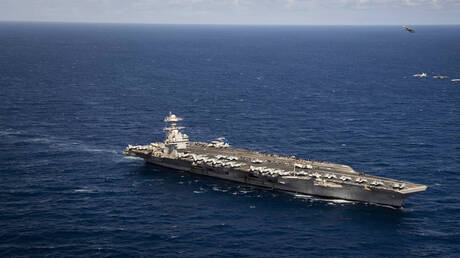
The US Navy, through the Sixth Fleet, has announced that the largest aircraft carrier in service, USS Gerald R. Ford, has set sail from the Croatian city of Split. This carrier, considered one of the newest and largest in the world, remains prepared to execute military missions in any operational area, reflecting the United States' commitment to enhancing its military presence in the region.
This move comes at a sensitive time as the Middle East experiences increasing tensions, with the United States seeking to bolster its rapid response capabilities in the event of any escalation. The USS Gerald R. Ford, which entered service in 2017, represents the new generation of aircraft carriers, featuring advanced technologies and high operational capabilities.
Details of the Departure
The USS Gerald R. Ford departed from Split after a period of maintenance and preparation. This carrier is capable of carrying a diverse range of military aircraft, including fighter jets and drones, making it a vital asset in any military operation.
This carrier is part of a carrier strike group that also includes two other aircraft carriers, reflecting the US Navy's strategy of deploying its forces in various regions around the world. This deployment comes at a time when concerns about escalating conflicts in the Middle East are rising, particularly with tensions between the United States and Iran, in addition to ongoing conflicts in Syria and Yemen.
Background & Context
Historically, US aircraft carriers have played a pivotal role in the United States' military strategies across the globe. Since World War II, these carriers have become symbols of US naval power, providing a launch platform for military aircraft and assisting in executing military operations swiftly and effectively.
In recent years, the Middle East has witnessed significant changes in the geopolitical landscape, increasing the importance of the US Navy's presence. Tensions among regional powers, coupled with threats from armed groups, necessitate that the United States be capable of rapid responses to any potential threats.
Impact & Consequences
This military deployment could have multiple effects on the region. On one hand, the presence of US forces may enhance stability in some allied countries, but at the same time, it could escalate tensions with adversarial nations. Many experts believe that this deployment could increase the likelihood of new conflicts, especially if perceived as a show of force.
Moreover, this deployment could impact relations between the United States and Arab countries, as some may view it as interference in internal affairs. However, others argue that the presence of US forces is essential to counter shared threats such as terrorism and extremism.
Regional Significance
Given the current situation, the presence of the USS Gerald R. Ford in the region may have direct implications for regional security. Arab countries, facing multiple security challenges, may see this deployment as an opportunity to enhance cooperation with the United States in security and defense.
On the other hand, Arab nations must be cautious of the repercussions of this deployment, as it may lead to increased tensions with certain regional powers. Ultimately, the current situation requires a delicate balance between enhancing security cooperation and maintaining national sovereignty.
In conclusion, the departure of the USS Gerald R. Ford from Croatia to the Middle East reflects the United States' commitment to strengthening its military presence in the region. Under the current circumstances, the question remains how this deployment will affect regional security and political balances in the Middle East.