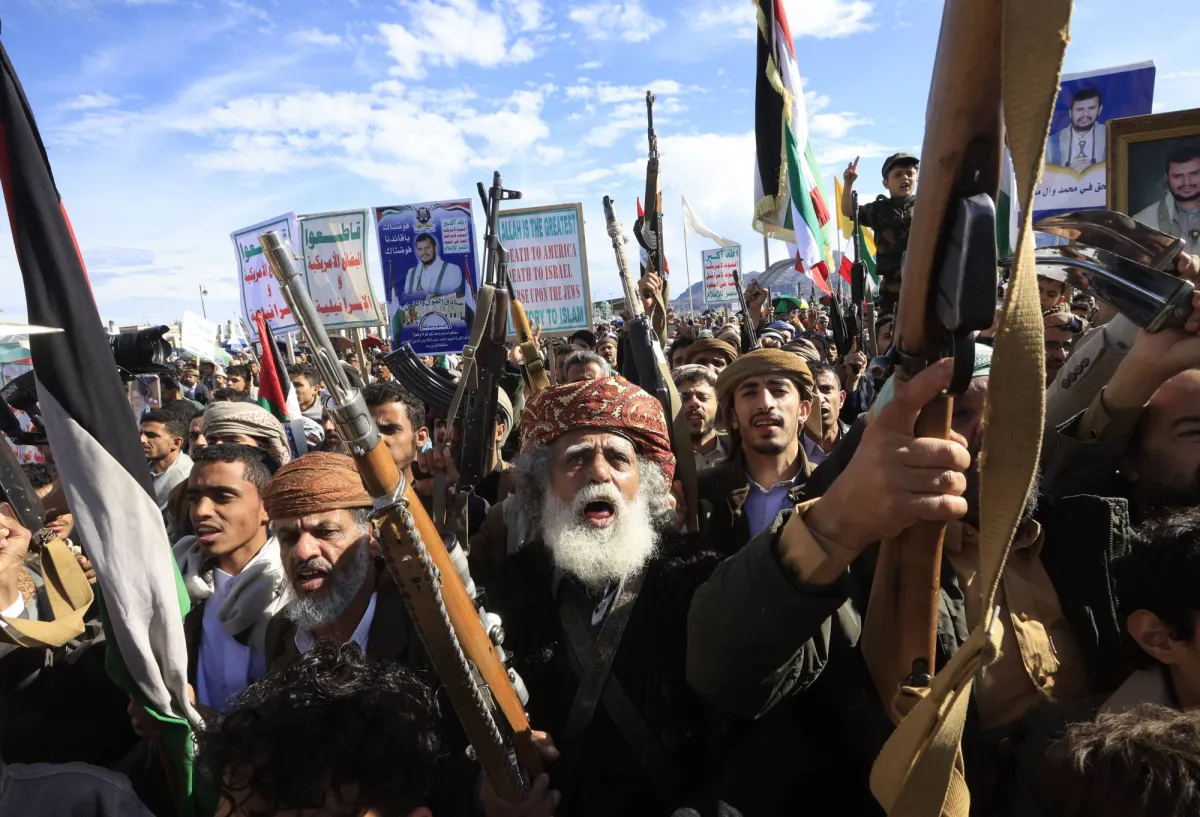
The Yemeni government has expressed its strong rejection of what it describes as Iranian policies aimed at destabilizing the region, accusing Tehran of attempting to drag Yemen into regional conflicts by supporting armed militias. This statement coincides with the announcement by the Houthi group of a new attack targeting Israel, marking the second such incident since their involvement in the war alongside Iran.
Amid increasing humanitarian concerns within Yemen, as well as international fears regarding the Houthis resuming maritime attacks against shipping vessels, the government confirmed in an official statement that these movements represent a direct threat to the country's sovereignty and undermine state institutions. It emphasized that the decision of war and peace must remain the prerogative of legitimate authorities.
Details of the Incident
The Yemeni government has accused the Iranian regime of following "destructive" policies aimed at undermining national states and seizing their sovereign decisions by supporting armed groups operating outside the framework of the state, foremost among them the Houthi group. It sees these actions as an extension of previous models in the region, where similar interventions have prolonged conflicts and turned countries into open battlegrounds serving external agendas at the expense of their peoples' interests.
The statement asserted that any military operations carried out outside the legitimate state institutions are considered "unlawful hostile acts," holding full responsibility for those behind them, whether they are executors or supporters, referring to Iran and the Houthis. The government warned that the continuation of this approach could expose national and regional security to serious risks, including threats to the unity and stability of the country, in addition to harming economic capabilities and raising food and energy prices.
Context and Background
In contrast, the Houthi group announced the execution of a "second military operation" using cruise missiles and drones, targeting, according to their statement, sites in southern Israel, as part of what they termed "the battle of holy jihad." The military spokesperson for the group, Yahya Saree, confirmed that these operations come as part of what he described as "support for the resistance axis," which includes Iran, the Lebanese "Hezbollah," and armed Iraqi factions.
This escalation is viewed as a shift that was expected in the group's stance, which had refrained from direct engagement during the initial weeks of the American-Israeli war, before later announcing its entry into the confrontation. The group emphasized that its operations will continue in the upcoming period, asserting that they will not cease until there is a "halt to the aggression," referring to the American-Israeli military operations against Iran and its proxies.
Impacts and Consequences
On the other hand, the Israeli army announced the interception of a missile launched from Yemen, marking the second such incident since the Houthis declared their military involvement, confirming that no losses occurred. It indicated ongoing coordination with the United States regarding how to deal with this escalation, amid expectations of retaliatory strikes against the Houthi group, similar to those that occurred over the past two years.
With the possibility of the Houthis resuming attacks on ships in the Red Sea, threatening one of the world's most important maritime routes, the European Maritime Mission (EUNAVFOR MED) confirmed the continuation of its defensive operations to ensure the security of international navigation. This maritime mission was established in February 2024, involving several military frigates, without engaging in direct confrontation with the Houthis.
Impact on the Arab Region
Concerns are growing regarding direct economic repercussions, including disruptions to global trade, rising transportation and insurance costs, alongside potential humanitarian implications for Yemen, which is already facing a severe living crisis. Furthermore, the continuation of military escalation in the region may exacerbate humanitarian conditions and increase the suffering of civilian populations in Yemen.
In conclusion, the current situation requires an urgent response from the international community to halt external interventions and unlawful military activities, and to provide necessary support to mitigate the increasing humanitarian crises in Yemen.