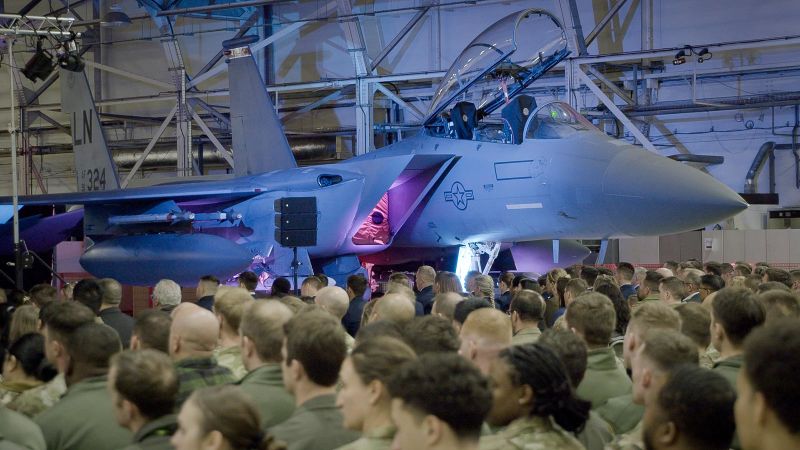
In a move that reflects the complexities of modern military conflict, an American fighter jet, the F/A-18E Super Hornet, has returned to the forefront, participating in ongoing operations against Iran while carrying a distinguished combat history. This fighter, identified as 402, took off from the aircraft carrier USS Gerald R. Ford as part of Operation Epic Fury, contributing to extensive military efforts.
The fame of this aircraft dates back to June 2017, when American pilot Michael Trimble executed an air support mission over Syrian territory. During this mission, the pilot engaged in direct combat with a Syrian Su-22 aircraft, launching two successive missiles after repeated warnings to the Syrian plane, which did not respond. This resulted in the first aerial shootdown of an enemy aircraft by the United States since 1999, and the first in the 21st century.
Details of the Current Operations
Today, the fighter jet appears in a different context, participating in military operations against Iran, reflecting the United States' ability to invoke its combat history to reinforce messages of power. This aircraft bears a kill mark on its fuselage, symbolizing its previous achievement, and has been repainted while retaining the same symbolism. This symbolism reflects how military capabilities can be used as deterrent tools in modern warfare.
This fighter operates within a diverse air formation that includes B-2 Spirit stealth bombers, F-22 Raptor, F-15 Eagle, and F-16 Fighting Falcon fighters, along with other naval aircraft. Data indicates that this air force, supported by land and naval assets, has executed thousands of strikes against targets within Iran as part of a large-scale military campaign.
Background & Context
Historically, U.S.-Iranian relations have witnessed increasing tensions, especially following the U.S. withdrawal from the nuclear agreement in 2018. Since then, American military operations in the region have escalated, as Washington seeks to bolster its military presence in the face of Iranian threats. These operations are part of a broader strategy aimed at deterring Iran from expanding its influence in the Middle East.
These operations are based on a deep understanding of the regional context, where Iran continues to support armed groups in Iraq, Syria, and Lebanon, complicating the security landscape. In this framework, warplanes like the F/A-18E Super Hornet are seen as symbols of American military power, demonstrating the readiness of the United States to intervene at any moment.
Impact & Consequences
The implications of these operations extend beyond mere military victories, as military symbolism plays a pivotal role in shaping public perceptions. The choice of this specific aircraft to appear in official footage reflects an awareness of the importance of visual narrative in shaping public opinion. In this context, the fighter is presented as evidence of the continuity of American air superiority, reinforcing the United States' position in the region.
These dynamics illustrate how military operations can be utilized as tools to enhance soft power, with warplanes considered part of a larger strategy aimed at deterring adversaries. This use of military symbolism also reflects how modern wars can transcend traditional battles, evolving into battles of narratives and images.
Regional Significance
These developments directly impact the Arab region, where Arab countries remain in a constant state of vigilance regarding events in Iran. American military operations against Iran are part of a broader strategy aimed at achieving stability in the region, but they may also lead to heightened tensions. Under these circumstances, Arab nations must exercise caution in their dealings with regional developments, as these operations can affect the balance of power in the area.
In conclusion, the participation of the F/A-18E Super Hornet in operations against Iran reflects not only the military readiness of the United States but also its ability to employ military symbolism in new contexts. These dynamics highlight the complex challenges facing the region and underscore the importance of a deep understanding of historical and political contexts.