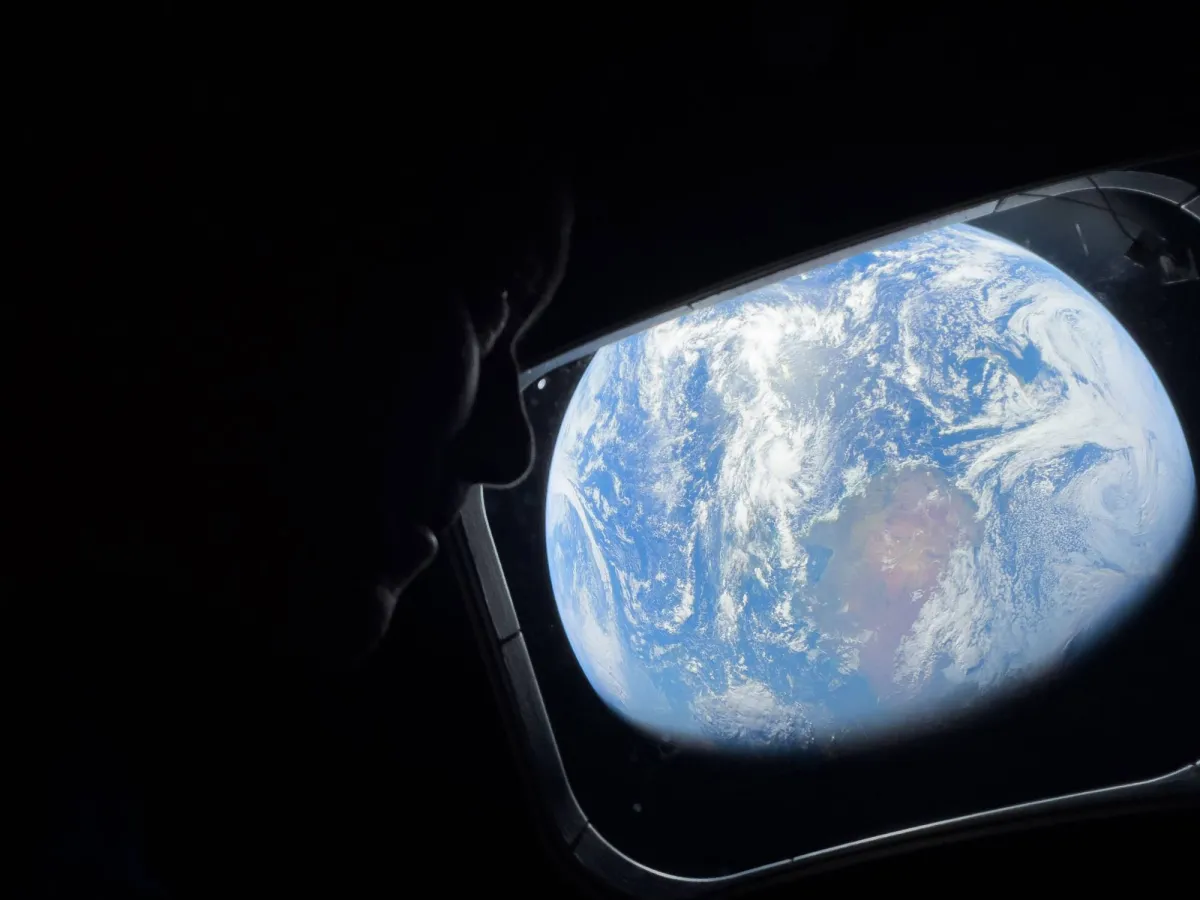
Four astronauts from the Artemis 2 mission entered lunar orbit on Monday, achieving an unprecedented milestone that represents a giant leap for humanity. They were able to observe parts of the moon that have never been seen by the naked eye before.
Setting a record for the distance traveled from Earth, the four astronauts—three from the United States and one Canadian—watched as the moon appeared larger. This flyby lasted for 6 hours and signifies NASA's first return to the moon since the Apollo era, paving the way for human footprints near the moon's south pole within two years.
Details of the Event
Less than an hour before entering lunar orbit, the four astronauts were set to become the farthest humans have ever traveled, surpassing the record of 400,171 kilometers set by the Apollo 13 spacecraft in April 1970. The mission control center anticipated that the Orion capsule of Artemis 2 would exceed this record by more than 6,600 kilometers.
Artemis 2 employs the same maneuver used by Apollo 13 after an oxygen tank explosion, known as the free lunar trajectory, which does not require stopping for landing, thus reducing fuel needs. This trajectory places the astronauts on a direct path back to Earth once they exit behind the moon.
The mission commander, American Reid Wiseman, along with pilots Victor Glover (the first African American to orbit the moon) and Christina Koch (the first woman to undertake this journey), and Canadian pilot Jeremy Hansen (the first non-American astronaut on this mission), are on course to pass within 6,550 kilometers of the moon. The Orion capsule will fly past the moon, complete a full orbit, and then head back to Earth.
Background & Context
Wiseman and his crew have spent years studying the moon's geography in preparation for this significant event, adding a solar eclipse to their list of tasks in recent weeks. By launching last Wednesday, they ensured they would witness a total solar eclipse from their position behind the moon.
One of their primary scientific objectives is the Orientale Basin, a massive crater formed by a colossal impact, consisting of three concentric rings, the outermost extending nearly 950 kilometers. A photo sent by the crew displayed this crater, which has only been seen previously through orbiting cameras.
Other objectives include the landing sites of Apollo 12 and Apollo 14 from 1969 and 1971, as well as the edges of the south pole region, which is the likely site for future landings. In more distant views, planets Mercury, Venus, Mars, and Saturn will also be visible, along with Earth.
Impact & Consequences
NASA geologist Kelsey Young, who oversees the mission, expects to capture thousands of images. She stated on the eve of the flyby, "People around the world connect with the moon; it is something every person on this planet understands and interacts with."
The Artemis 2 mission is NASA's first crewed mission to the moon since Apollo 17 in 1972. It paves the way for Artemis 3 next year, which will involve training another crew from the Orion spacecraft to dock with lunar landing vehicles in Earth orbit, followed by astronauts landing on the moon's surface near the south pole as part of Artemis 4 in 2028.
Regional Significance
This mission represents a significant scientific and technological achievement, reflecting humanity's ability to explore space and expand knowledge horizons. The success of this mission may encourage Arab nations to enhance their investments in space, contributing to technological development and scientific research in the region.
In conclusion, the Artemis 2 mission stands as a landmark in space history, opening new avenues for exploration and emphasizing the importance of international cooperation in achieving scientific milestones.