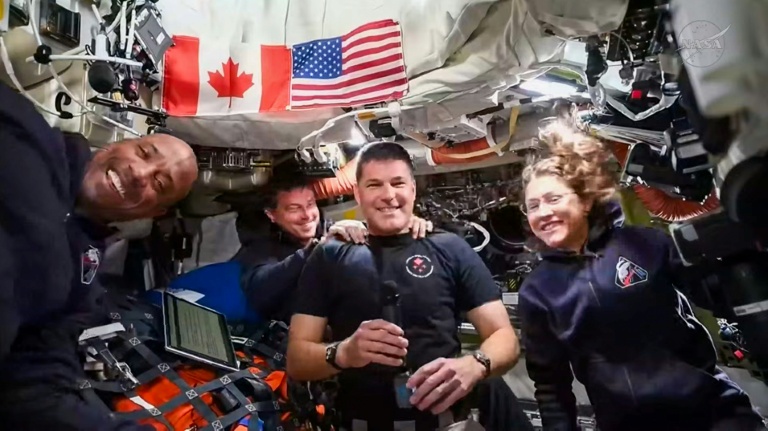
The four astronauts of NASA's Artemis 2 mission have entered their fifth day on a historic journey to the Moon, witnessing its surface from unprecedented angles. On Sunday morning, their Orion spacecraft was approximately 215,000 miles (346,000 kilometers) from Earth and 65,000 miles from the Moon, according to NASA data.
Former astronaut Charlie Duke, who walked on the Moon in 1972 as part of Apollo 16, provided a celebratory wake-up call for the crew. The 90-year-old Duke said, "You have a picture of my family on the Moon. I hope it reminds you that we in America and around the world are cheering for you. Thank you and the entire team for building the Apollo legacy with Artemis."
Event Details
In the early hours of Sunday, NASA released a photo taken by the Artemis crew, showing the far side of the Moon with the visible Orientale Basin. NASA confirmed that this mission represents the first time the basin has been seen in its entirety by human eyes. The massive crater, resembling a target, had previously been photographed by orbiting cameras.
Astronaut Christina Koch expressed the crew's excitement about seeing the basin, sometimes referred to as the "Grand Canyon of the Moon," during a live call with Canadian children. Koch stated, "It is very special and has not been seen by human eyes until today, when we were fortunate to see it."
Background & Context
The Artemis 2 mission is part of NASA's ambitious program to explore the Moon, aiming to return humans to its surface by 2024. This program represents a significant step towards future Mars exploration. Since the first Apollo mission landed on the Moon in 1969, numerous technological advancements have made these journeys safer and more efficient.
Through this mission, NASA aims to test new systems and monitor how astronauts interact with the spacecraft in a space environment. This information will be vital for developing future missions, including the lunar landing in Artemis 4 in 2028.
Impact & Consequences
The Artemis 2 mission is a crucial step towards achieving space exploration goals, as it will help gather necessary data to understand how life support systems function in space. Jared Isaacman, NASA's Administrator, stated that they are focusing heavily on life support systems and their functionality within the spacecraft.
The fifth day's plan includes testing the astronauts' survival suits, which are used during launch and re-entry, as well as in emergencies such as cabin depressurization. The crew will conduct a full series of operations related to the suits, including wearing and pressurizing them, conducting leak checks, simulating seat ingress, and assessing mobility and the ability to eat and drink.
Regional Significance
This historic mission serves as an inspiration for Arab countries seeking to enhance their space programs. With growing interest in space exploration in the region, NASA's achievements could motivate the development of local space initiatives. Additionally, international collaboration in space could open new avenues for Arab countries in research and technology.
In conclusion, the Artemis 2 mission marks a milestone in the history of space exploration, as astronauts strive to achieve unprecedented accomplishments, paving the way for a bright future in lunar and Mars exploration.