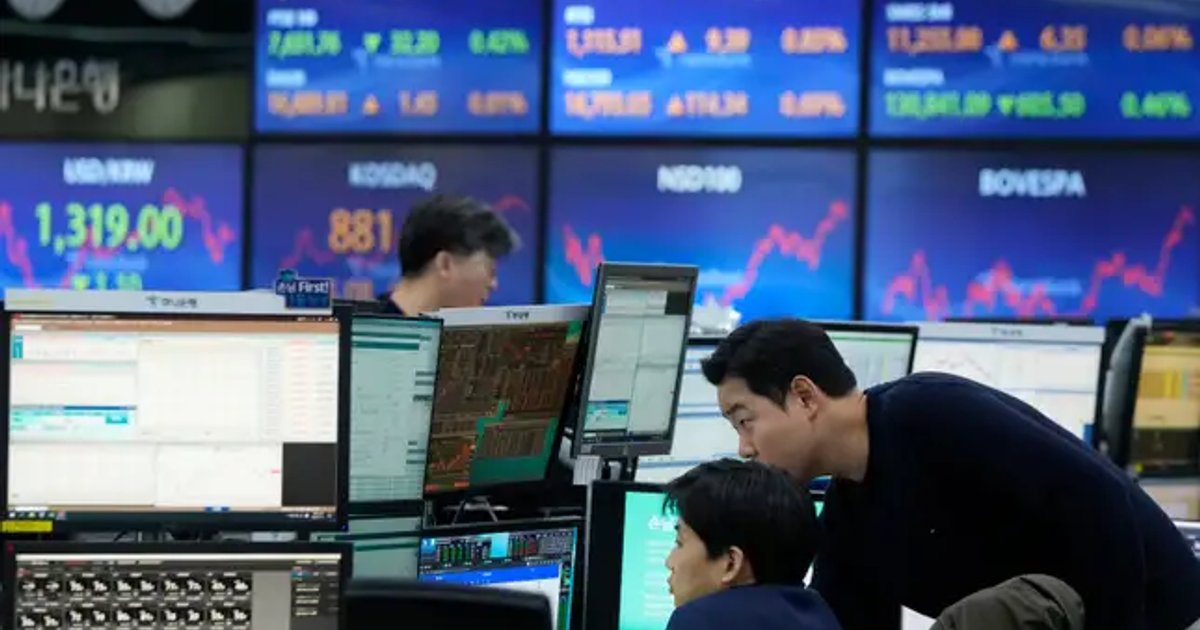
Asian stock markets witnessed a sharp decline during Friday's trading sessions, as fears of a correction in the technology sector and escalating military tensions in the Middle East drove investors to take profits and seek safe havens before markets closed for the weekend.
The decline coincided with Hezbollah rejecting a new US proposal for a ceasefire in Lebanon, while Israel announced its insistence on maintaining troops in border areas, dashing the hopes of President Donald Trump's administration in reaching a comprehensive diplomatic settlement that includes Iran's nuclear file.
Trading Details and Key Figures
Morning trading data showed broad declines in major indices, with the MSCI Asia Pacific ex-Japan Index falling by 1.8%, recording its largest daily loss in weeks. In Seoul, the KOSPI South Korean index collapsed by 7%, affected by intensive selling in technology and semiconductor company stocks that form the backbone of the Korean economy.
In Tokyo, the Nikkei 225 index retreated by approximately 1.6%, amid fears of potential intervention to support the local currency, as the Japanese yen remained trading near the level of 160 yen against the dollar, recording 159.95 in the latest transactions, despite repeated warnings from the Japanese Ministry of Finance regarding the risk of currency weakness on imports and inflation.
Background and Market Context
The current selling wave comes in the context of a correction in the artificial intelligence sector that continued for the second consecutive day, after Broadcom, the American chip manufacturing company, disappointed investors with financial results that fell below expectations, raising questions about the sustainability of spending on data centers and AI infrastructure. This led to a wave of profit-taking that extended from Wall Street to markets in Tokyo, Hong Kong, and Sydney.
On the geopolitical front, the military escalation in Lebanon and tensions on the southern border add a character of uncertainty that drives capital away from high-risk assets. Hezbollah rejected the ceasefire proposal mediated by Washington, insisting on conditions related to complete Israeli withdrawal, while Tel Aviv announced its intention to maintain military points inside Lebanese territory, meaning the continuation of a state of open war and closing the door to any near-term regional economic stability.
Implications and Market Impact
The current decline reflects a shift in global investor sentiment from excessive optimism to extreme caution, amid fears that technology stocks, particularly those related to artificial intelligence, may have reached levels exceeding their true value. The continuation of this wave may lead to a repricing of risk in emerging markets, and push major investment funds to reduce their exposure to Asian stocks in favor of government bonds and gold.
Furthermore, yen weakness, despite providing support for Japanese exports, raises increasing concerns about the stability of financial markets in East Asia, especially with the possibility of sudden intervention by the Bank of Japan to support the currency, which could lead to sudden financial turmoil in global money markets. Investors remain on alert for upcoming US inflation data that may determine the Federal Reserve's direction in its next meeting.
Regional Significance for Arab Markets
Despite their geographical distance, Arab financial markets, particularly in Gulf states, are closely linked to Asian performance through mutual investments and extensive trade ties. The decline in Seoul and Tokyo markets may negatively affect foreign direct investment flows coming into the Arab region, especially in technology and renewable energy sectors that are witnessing major Saudi and Emirati expansion.
Moreover, the continuation of tensions in Lebanon and the failure of ceasefire efforts add pressure to neighboring Arab economies, and increase insurance costs for maritime shipping in the Mediterranean, which may be reflected in imported goods prices in Arab countries. In this climate, attention may turn to oil markets as an indicator of the severity of the crisis, as markets worry that any new military escalation may affect global energy supplies and add a new burden to Arab economies seeking recovery after years of disturbances.