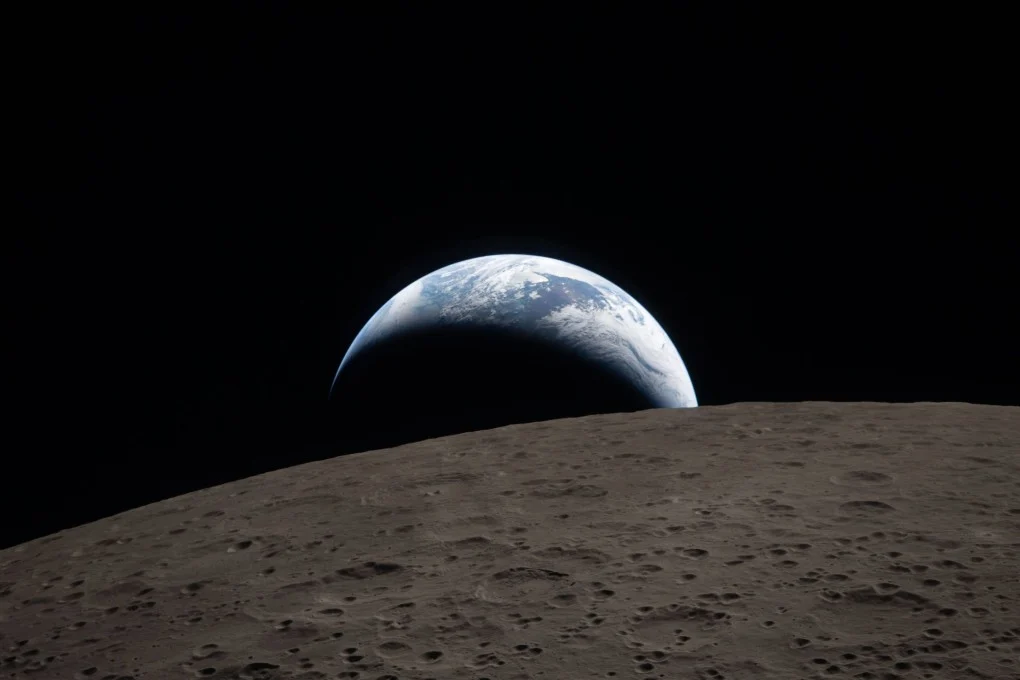
Astronauts participating in the Artemis II mission captured a stunning image of Earth setting behind the lunar horizon during their long journey back home. This historic moment occurred on Tuesday after the mission, which included a historic flyby around the Moon. The image released by NASA showcases Earth descending behind the rugged edges of the Moon, reflecting the beauty of the universe and evoking memories of the famous Earth photo taken by astronaut Bill Anders during the Apollo 8 mission 57 years ago.
This image is part of NASA's efforts to re-explore the Moon, representing a significant step towards returning to the Moon and exploring deep space. The astronauts involved in this mission are among those who will carry humanity back to the Moon, opening new horizons for scientific research and technology.
Details of the Event
The Artemis II mission included a flyby around the Moon, where the astronauts gathered important data about the Moon and its surrounding environment. The captured image reflects the unique moment when Earth sets, adding both aesthetic and scientific dimensions to this mission. NASA hopes that this image will inspire a new generation of scientists and engineers to explore space.
The photo released by NASA also serves as a reminder of the importance of international cooperation in space exploration. Many countries are working together to achieve common goals in the field of space, reflecting the spirit of collaboration and scientific advancement.
Background & Context
The history of space exploration is filled with historic moments that have changed our understanding of the universe. The image of Earth taken by Bill Anders during the Apollo 8 mission was one of those moments, contributing to a shift in humanity's perspective of our planet. That image served as a call to reflect on the environment and the resources we have on Earth.
The Artemis II mission is part of the Artemis program, which aims to return to the Moon by 2024. This program is part of a larger vision for exploring Mars and deep space, as NASA seeks to develop new technologies that will enable humanity to live and work in space.
Impact & Consequences
This mission is an important step towards achieving space exploration goals. The captured image reflects the natural beauty of Earth and highlights the importance of preserving our planet. This historic moment also contributes to raising public awareness about the significance of science and technology in our daily lives.
Developments in the field of space exploration may also impact various sectors such as education and the economy. These new achievements can inspire young people to engage in science, technology, engineering, and mathematics (STEM) fields, contributing to the development of the skills needed to face future challenges.
Regional Significance
Although the Artemis II mission is related to the United States, its impact extends worldwide, including the Arab region. International cooperation in space can open new horizons for Arab countries in scientific research and technology.
Moreover, the growing interest in space can encourage Arab nations to invest in their own space programs, contributing to the development of their scientific and technological capabilities.
In conclusion, the image of Earth captured by astronauts in the Artemis II mission represents a historic moment that reminds us of the beauty of our planet and the importance of exploring space. These achievements are not just scientific milestones but a call for everyone to reflect on our future on this planet.