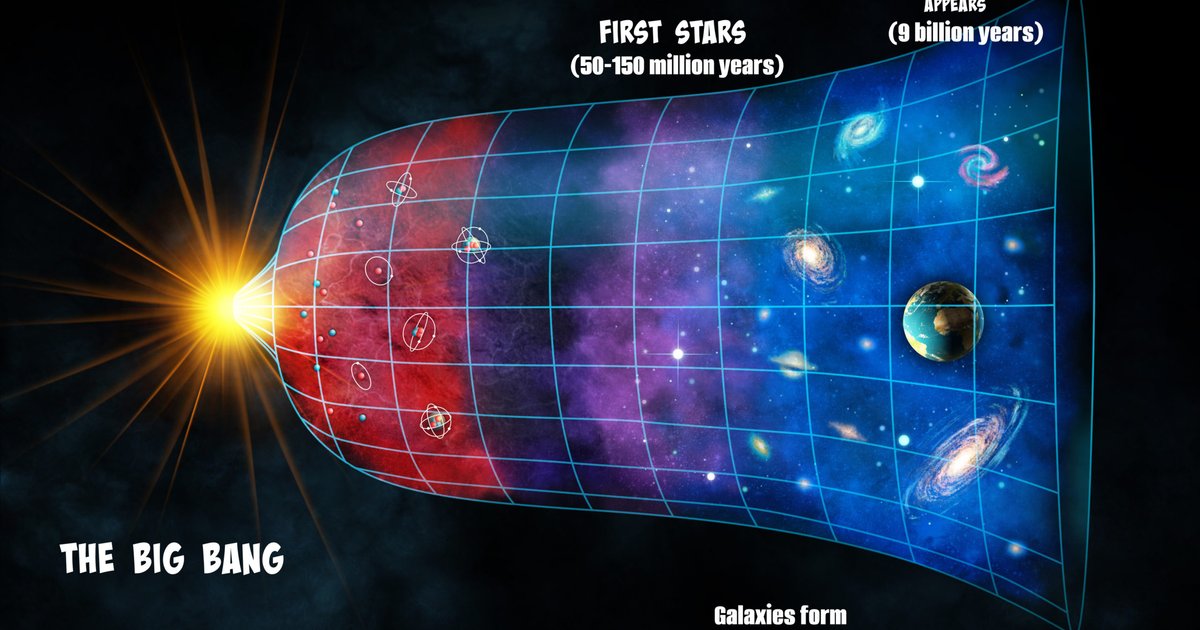
Recent scientific research raises intriguing questions about the Big Bang Theory, which is considered one of the most prominent theories in astrophysics. In light of recent developments, science emerges as a tool for understanding reality rather than possessing absolute truth. This theory, which explains how the universe originated and evolved, faces new challenges that require us to rethink our fundamental concepts about the universe.
Historically, the Big Bang Theory has been the dominant explanation for the origin of the universe, positing that the universe began from a point of infinite density and temperature about 13.8 billion years ago. However, advancements in fields such as general relativity and quantum mechanics have raised questions about the accuracy of this theory. Could it merely be a scientific myth?
Details of Recent Discoveries
Recent research includes a series of discoveries that may reshape our understanding of the universe. For instance, strange signals from outer space have been detected, raising questions about whether there are other cosmic events that could explain the origin of the universe differently. Additionally, studies on black holes and dark matter may provide new insights into how the universe evolved after the Big Bang.
Moreover, scientists are investigating phenomena such as the accelerating expansion of the universe, which contradicts some of the fundamental assumptions of the Big Bang Theory. These discoveries may compel scientists to reevaluate the foundations upon which this theory is built.
Background & Context
The roots of the Big Bang Theory trace back to the early 20th century when Albert Einstein introduced the theory of general relativity, which transformed our understanding of gravity, time, and space. As research progressed, this theory was supported by astronomical observations such as the discovery of the cosmic microwave background radiation, which is considered strong evidence for the Big Bang.
Nevertheless, the new challenges facing this theory require scientists to think more deeply about the nature of the universe. Are there alternative theories that could explain the origin of the universe more accurately? This question opens new avenues for scientific research.
Impact & Consequences
If it turns out that the Big Bang Theory is not as we believed, it would significantly impact many fields of science, including astrophysics and philosophy. It may necessitate a reevaluation of how we understand time and space, potentially leading to the development of new theories about the universe.
These developments could also affect how science is taught in schools and universities, as curricula will need to adapt to new concepts. This change could stimulate further research and discoveries in the future.
Regional Significance
In the Arab region, science and scientific research are fields that require greater support. With the growing interest in astrophysics, Arab countries can play an important role in research related to the universe. By investing in education and research, Arab nations can contribute to a deeper understanding of the universe and its challenges.
Enhancing scientific research in the region could lead to new discoveries that contribute to the development of scientific knowledge, thereby enhancing the status of Arab countries on the global stage.
In conclusion, the Big Bang Theory remains a contentious topic in scientific circles. As research and discoveries continue, we may be on the brink of a new understanding of the universe, opening new horizons for scientists and researchers.