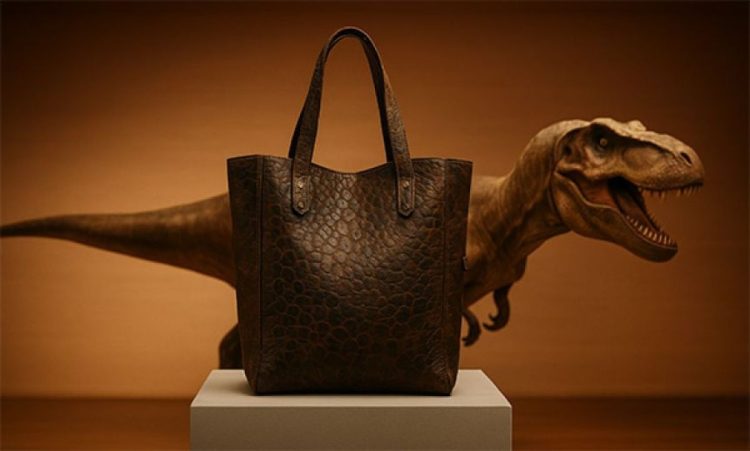
A group of scientists and designers has unveiled a unique handbag made from dinosaur leather, reigniting a scientific debate about the possibility of recovering proteins from the fossils of these extinct creatures. The handbag, showcased at the 'Art Zoo' museum in Amsterdam, will be auctioned starting at half a million dollars.
This handbag comes nine years after a controversy sparked by researchers from the National Central University of Taiwan, who announced in 2017 the discovery of preserved proteins within a dinosaur fossil estimated to be around 195 million years old. This achievement was published in the journal 'Nature Communications,' focusing on a rib bone from a dinosaur of the 'sauropodomorph' group.
Event Details
In this context, scientists confirmed that they managed to detect preserved organic remains within vascular channels, which are the fine pathways through which blood vessels and nerves passed in the living organism. Using advanced analytical techniques, distinctive chemical signatures of collagen protein were revealed, which is one of the essential components of biological tissues.
The results showed scientifically known absorption ranges, which is a strong indicator of the presence of preserved protein structures. However, this study was not without criticism, as another study from the University of Manchester in the UK questioned the accuracy of the results, suggesting the possibility of recent contamination.
Background & Context
These studies have sparked widespread debate about the possibility of recovering proteins from dinosaur fossils, with some arguing that collagen can only remain in these fossils in minimal amounts. Experts have confirmed that any extracted material lacks the complete structure that characterizes natural skin.
At the same time, the handbag project owners consider the criticisms to be a natural part of new innovations, asserting that what they have achieved represents the closest attempt to revive a material that can be attributed to dinosaurs.
Impact & Consequences
This handbag raises questions about the possibility of recovering materials from extinct organisms, potentially opening new horizons in scientific research and biotechnology. Additionally, this project may contribute to enhancing interest in natural and historical sciences.
Furthermore, these innovations could lead to the development of new techniques in environmental conservation and the restoration of extinct species, reflecting the importance of scientific research in understanding the history of life on Earth.
Regional Significance
Although this event may seem distant from the Arab region, it highlights the importance of scientific research and innovation worldwide. Such projects can inspire scientists and researchers in Arab countries to explore new fields in science and technology.
Ultimately, this handbag remains a symbol of scientific curiosity and the challenges faced by scientists in their quest to understand the past, reflecting the importance of continuing research and development across all fields.