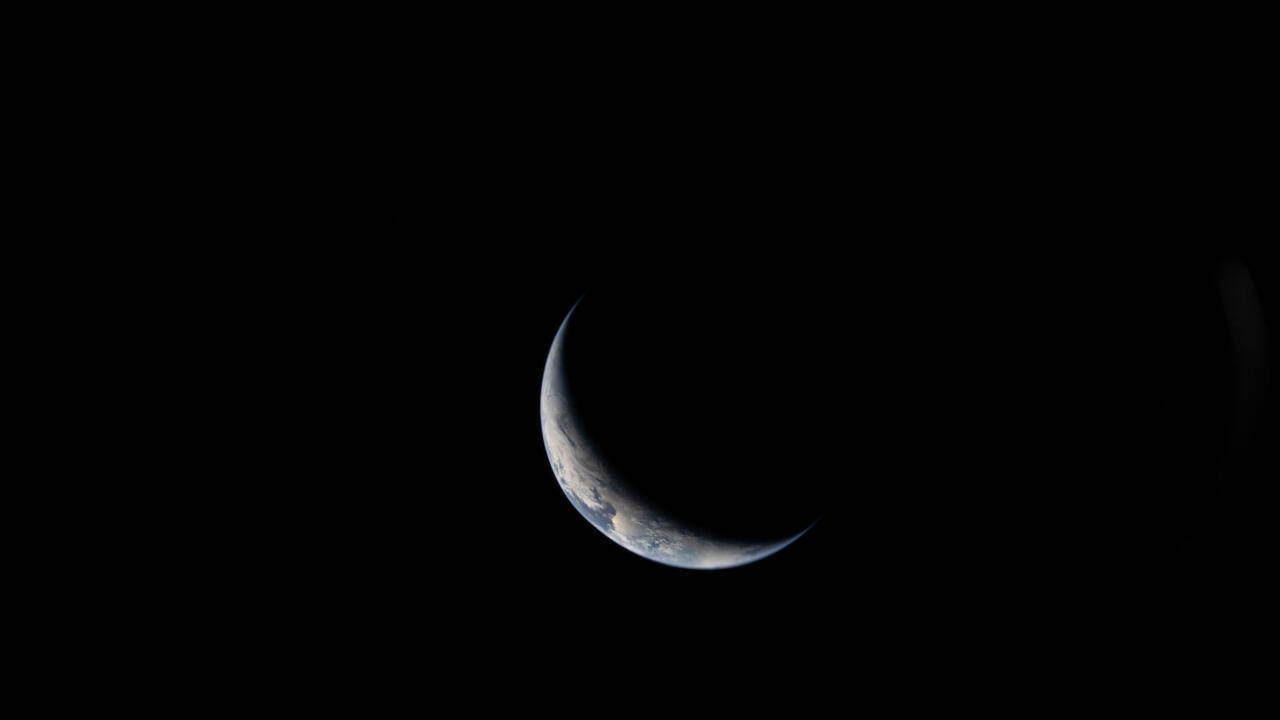
The crew of 'Artemis' entered the Moon's gravitational influence at 04:42 GMT on Monday, approximately 63,000 kilometers from the lunar surface and about 373,000 kilometers from Earth, according to a NASA official during the live broadcast of the mission.
At this critical moment, the Moon's gravity becomes more influential on the spacecraft than that of Earth. The 'Orion' spacecraft will begin orbiting the Moon, meaning the crew will make history by reaching the farthest point from Earth ever achieved by humans.
Details of the Historic Event
This historic mission features notable achievements by a crew consisting of three Americans and one Canadian. Victor Glover will be the first person of color to orbit the Moon, while Christina Koch will be the first woman to achieve this feat. Canadian Jeremy Hansen will be the first non-American to accomplish this milestone.
The astronauts, accompanied by mission commander Reid Wiseman, will spend most of their time orbiting the Moon documenting their observations. The team has already begun to see lunar landmarks that no human has ever seen before. On Sunday, NASA released a photo taken by the 'Artemis' team of the Moon from a distance, showcasing what is referred to as the 'Eastern Sea.'
Background & Context
This mission is part of the 'Artemis' program, which aims to explore the Moon and prepare the infrastructure for future missions to Mars. NASA has confirmed that this is the first time the entire basin has been seen by human eyes. The massive crater, resembling a center circle, has previously been captured by orbiting cameras.
During a Q&A session with Canadian children, Christina Koch expressed her excitement about seeing the basin sometimes referred to as the 'Grand Canyon' of the Moon, noting that the view is 'very special' and that no human eye has seen this crater before.
Impact & Consequences
Before the end of their lunar orbit, the astronauts will witness a solar eclipse, where the Sun will be obscured behind the Moon, revealing only its outer atmosphere known as the solar corona. The four astronauts will also spend time testing the 'Orion Crew Life Support System' suits, which protect them during launch and re-entry to Earth.
These orange suits are essential in emergencies, providing breathable air for up to six days. The four astronauts are the first to wear these suits in space, and they will test their functionality and how quickly they can don them.
Regional Significance
This mission represents an important step in space exploration, reflecting the scientific and technological advancements that could influence Arab nations seeking to develop their own space programs. The success of this mission may encourage further international cooperation in space, benefiting all nations.
In conclusion, the 'Artemis' mission marks a historic achievement in space exploration, opening new horizons for lunar exploration and the development of new technologies that can benefit all of humanity.