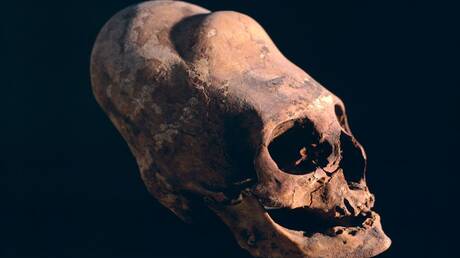
A recent genetic analysis has failed to determine the origins of the cone-shaped Paracas skulls, reviving old theories that associate these skulls with extraterrestrial beings. These results have raised new questions about the nature of these skulls, which have been a subject of debate and scientific discussions for decades.
The Paracas skulls date back to the ancient Paracas civilization that thrived along the coast of Peru, and they were discovered in tombs dating back to around 300 BC. These skulls are characterized by their conical shape, which has intrigued scientists and researchers, as they are considered a unique specimen in anthropology.
Details of the Event
Genetic studies were conducted on these skulls to understand their origins and determine whether they belong to a known human species. However, the results were disappointing, as they could not provide definitive answers. This failure to identify their origins has resurfaced old theories discussing the existence of extraterrestrial beings or unknown civilizations.
These theories include claims that the shape of the skulls may be the result of external intervention, raising questions about how humans evolved during that era. Scientists who studied these skulls have confirmed that their unique shape may be a result of local cultural practices related to cranial shaping, but these explanations have not fully resolved the mystery.
Background & Context
Historically, the Paracas civilization was known for its advanced mummification techniques and textile arts. However, the available information about this civilization remains limited, adding to the mystery surrounding it. The conical skulls are not the only controversial findings; there are many other archaeological discoveries in the region that raise questions about the evolution of ancient civilizations.
The Paracas skulls are considered part of a rich cultural heritage and have attracted the interest of researchers in various fields, from archaeology to biology. However, the inability to accurately determine their origins highlights the knowledge gaps in our understanding of human history.
Impact & Consequences
These findings raise questions about how these discoveries will affect our understanding of human history. If these skulls indeed belong to extraterrestrial beings, this could radically change our perception of human history and evolution. On the other hand, if they are linked to local cultural practices, this highlights the cultural and historical diversity witnessed by ancient civilizations.
These discoveries continue to stimulate scientific and theoretical discussions, reflecting the importance of ongoing research in this field. Scientists are calling for further studies and research to gain a deeper understanding of these skulls and their origins.
Regional Significance
Although the Paracas skulls are located in South America, their impact extends to the Arab region through a shared interest in cultural heritage and scientific research. Many Arab scientists are involved in research related to archaeology and history, enhancing international cooperation in this field.
These discoveries present an opportunity to enhance mutual understanding between different cultures, as they can contribute to fostering dialogue about human history and its evolution. Understanding the origins of ancient civilizations can significantly impact how modern societies view their cultural heritage.