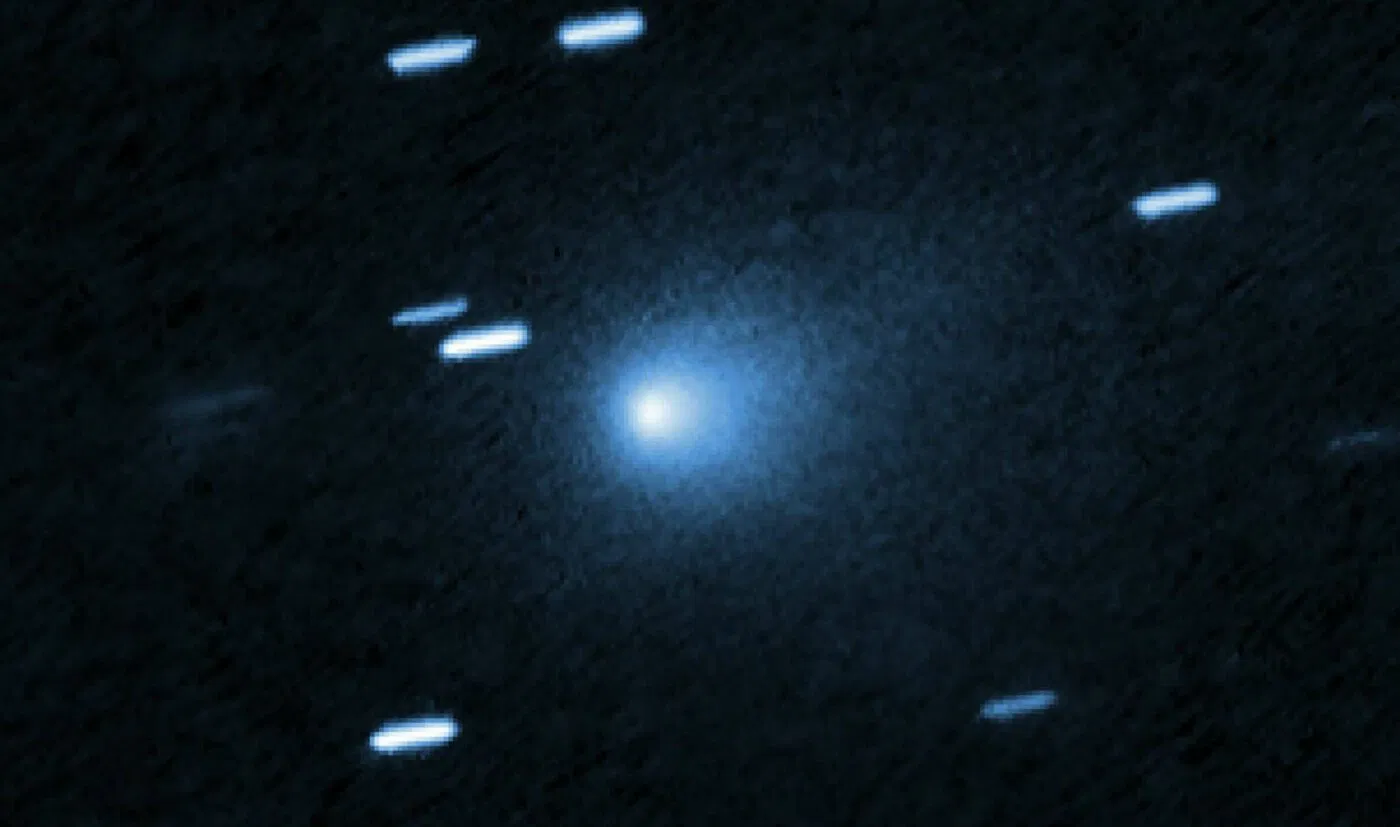
Scientists have discovered that the interstellar comet 'Atlas' (3I/ATLAS) may be between 10 and 12 billion years old, making it one of the oldest cosmic bodies to visit our solar system. This discovery provides a unique window into the early days of the Milky Way galaxy and enhances our understanding of planetary formation history.
The comet 'Atlas' entered our solar system in 2020, becoming one of three interstellar objects, preceded by 'Oumuamua' in 2017 and 'Borisov' in 2019. Analyses indicate that its isotopic composition, including near-infrared spectrometer data from the James Webb Space Telescope, suggests it originated before the spread of the carbon-13 isotope in the galaxy, placing its formation in the early days of the Milky Way.
Details of the Discovery
In an official press release, Martin Cordiner from NASA's Goddard Space Flight Center stated, "The older Comet Atlas is, the more realistic this possibility seems." The chemical composition of the comet indicates it is a remnant from an ancient planetary system that no longer exists, making it a unique reference for understanding the formation of early planetary systems. The comet contains complex carbon molecules such as methanol, formaldehyde, and methane, reinforcing the idea that the building blocks of life may have been widespread in the galaxy long before our solar system formed.
Although the comet's trajectory is complicated due to gravitational interactions over billions of years, Cordiner believes that "the older Comet Atlas is, the more likely it came from the thick disk of the Milky Way around its center." This evidence suggests that the comet may be a survivor from a very ancient region of the galaxy, providing invaluable information about the history of planetary formation and the potential for life beyond our solar system.
Background & Context
Historically, comets are considered cosmic bodies that carry secrets of the solar system and galaxy's formation. These bodies are remnants from ancient times, formed in the early universe. Comet 'Atlas' is not the first of its kind, as it follows several interstellar comets, but its long age makes it unique.
The importance of studies on comets is increasing amid ongoing research into the formation of life in the universe. Studies suggest that many essential elements for life may be present in comets, bolstering the hypothesis that life could be common in the galaxy.
Impact & Consequences
This discovery opens new horizons for understanding how planets and life form in the universe. It also underscores the importance of astronomical research and encourages further explorations in space. This information could contribute to developing new theories about how life originated elsewhere in the galaxy.
Furthermore, understanding planetary system formation can help scientists identify potential locations to search for life beyond Earth. Comets like 'Atlas' may hold the key to understanding more about the universe's history and the evolution of life.
Regional Significance
For the Arab region, this discovery highlights the importance of investing in science and technology, especially in the field of space. Astronomical research can foster international cooperation and knowledge exchange, benefiting Arab countries in scientific research and development.
Moreover, enhancing scientific understanding of the universe can inspire new generations of scientists and researchers in Arab countries, contributing to building a better future in science and technology.
In conclusion, Comet 'Atlas' represents a unique opportunity to explore the history of the universe and the evolution of life, reflecting the importance of astronomical research in understanding the cosmos around us.