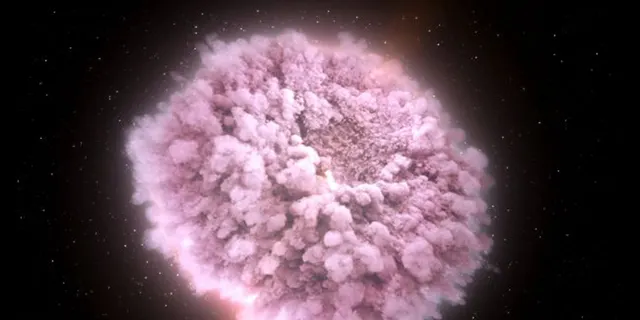
Astronomers have uncovered indirect evidence supporting the hypothesis of a rare type of stellar explosion known as 'unstable binary explosions,' which could lead to the disappearance of massive stars without leaving a trace. This discovery, announced in a study published in the journal Nature, highlights how massive stars interact with gravitational forces and energy at the end of their lives.
This study pertains to massive stars with masses ranging from 140 to 260 times that of the Sun. The researchers, led by Hui Tong, a PhD student in astrophysics at Monash University in Australia, noted that these stars have relatively short lifespans, lasting only a few million years, compared to the Sun, which lives for about 10 billion years.
Details of the Stellar Explosions
Stellar explosions occur when stars explode at the end of their life cycles, releasing vast amounts of material into space. Typically, these explosions leave behind stellar remnants such as neutron stars or black holes. However, massive stars that exceed a certain mass threshold may undergo extremely violent explosions, known as 'unstable binary explosions,' resulting in no remnants being left behind.
In this study, the researchers analyzed data related to 153 pairs of black holes, measuring their masses based on the gravitational waves they emitted. They observed a notable absence of black holes with masses between 44 and 116 times that of the Sun, a phenomenon they termed the 'forbidden range.' This absence may be explained by the destruction of larger stars in rare explosions, leaving a void in this mass range.
Background & Context
Since the 1960s, scientists have hypothesized the existence of these super-powerful explosions, but have been unable to provide direct evidence until now. Stellar explosions are considered among the most violent phenomena in the universe, and a type of explosion known as 'superluminous supernovae' has been observed, which are candidates for being 'unstable binary explosions.' These explosions can be more than 10 billion times brighter than the Sun.
Recent research indicates that these stellar explosions may be rare and difficult to observe, making precise identification challenging. However, the evidence presented in this study is considered one of the best indicators to date of the existence of 'unstable binary explosions.'
Impact & Consequences
These discoveries are significant for our understanding of the universe, as they open new avenues for studying how massive stars evolve and meet their ends. Understanding how gravity and energy interact in massive stars may help scientists explain many other cosmic phenomena.
Moreover, these findings could impact our current models regarding how black holes form and distribute throughout the universe. They may also lead to a reevaluation of theories related to the origin of heavy elements in the cosmos.
Regional Significance
For the Arab region, these discoveries highlight the importance of scientific research in astronomy and physics, potentially inspiring a new generation of scientists and researchers in the Arab world. Additionally, enhancing collaboration in astronomical research could contribute to the advancement of scientific knowledge in the region.
In conclusion, these discoveries represent a significant step towards a deeper understanding of the universe and pave the way for further research and studies that may alter our perceptions of cosmic phenomena.