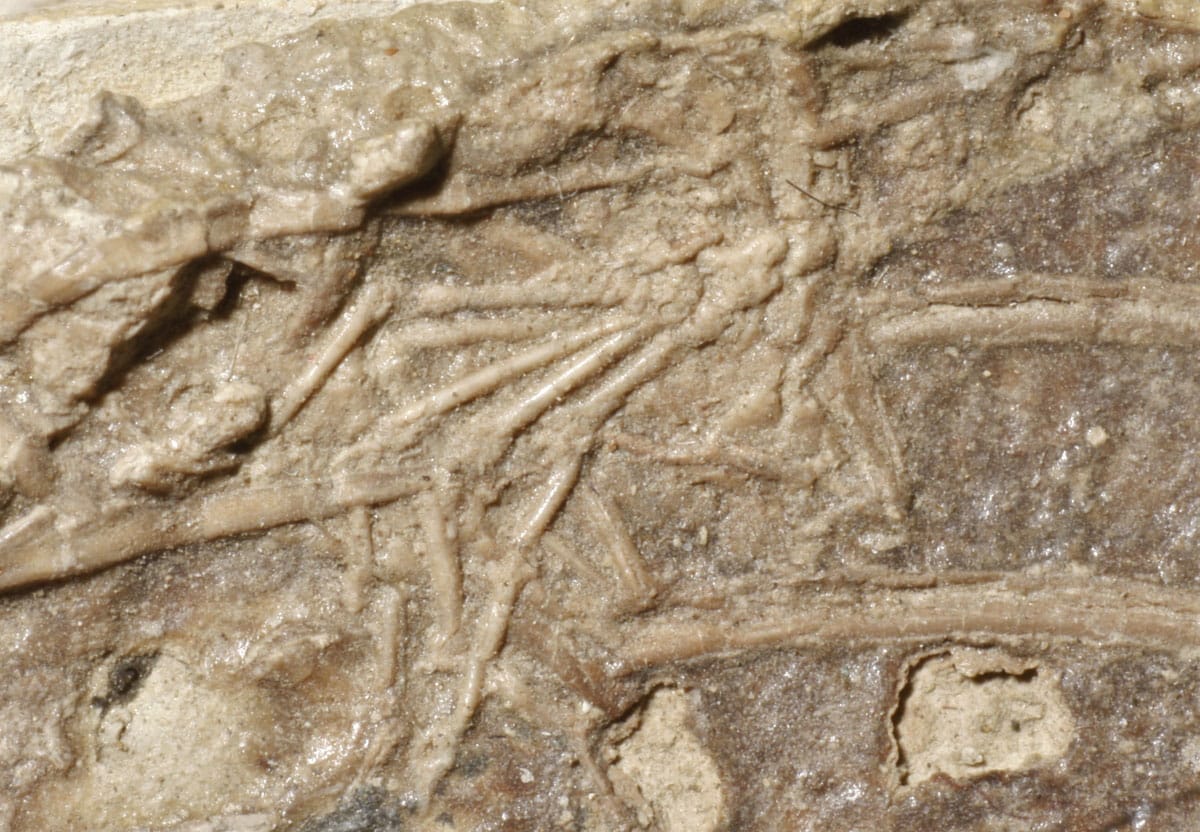
A recent study has revealed that a fossil recently announced as a new type of ancient flying reptile, known as a pterosaur, is in fact just fish remains. This discovery brings to mind famous scientific errors from nearly a century ago.
The story dates back to November 2025, when a team of researchers led by Brazilian paleontologist Rodrigo Pigas announced the discovery of a new creature they named Bakerypo Waritza, based on a fossil found in rocks dating back to the early Cretaceous period in northeastern Brazil.
Details of the Discovery
This discovery sparked widespread interest, especially with an intriguing hypothesis suggesting that the specimen could be the remains of a massive predatory dinosaur's vomit, possibly resembling a spinosaurus. However, it wasn't long before criticism began to be directed at this finding, as an international team of paleontologists started reviewing the published data and images.
During this review, scientists discovered clear inconsistencies in the structure of the 'teeth' and bones attributed to the new creature. Analyses showed that these structures did not match the characteristics of pterosaurs and lacked essential features such as dental roots and known microstructure.
Background & Context
Historically, errors in fossil classification stem from similar cases, such as what happened in 1939 when paleontologist Ferdinand Broili mistakenly classified a fossil named Belonokazma, which was later revealed to be merely fish gills. These mistakes reflect the ongoing challenges in paleontology, where researchers often rely on incomplete remains.
This incident highlights the significant transformation brought about by the digital age in the pace of scientific research. While such errors used to take decades to uncover, it is now possible to detect and correct them within weeks or months.
Impact & Consequences
This study, published in the journal PALEONTOLOGY, confirms that Bakerypo is merely a collapsed gill arch of a large fish, preserved alongside remains of smaller fish. This discovery underscores the importance of accuracy in paleontology and indicates the ongoing need for regular review of scientific data.
Moreover, this type of error can affect our understanding of the history of life on Earth, as misclassifying fossils may lead to incorrect conclusions about species evolution and their relationships.
Regional Significance
In the Arab region, the study of fossils is an important part of understanding the biological history of the Earth. Such discoveries can contribute to enhancing scientific knowledge and developing educational curricula in universities and institutes. Furthermore, advancements in this field may open new avenues for scientific research in Arab countries.
In conclusion, this discovery serves as a reminder of the importance of accuracy in scientific research and reflects the challenges scientists face in their quest to understand the history of life on our planet.