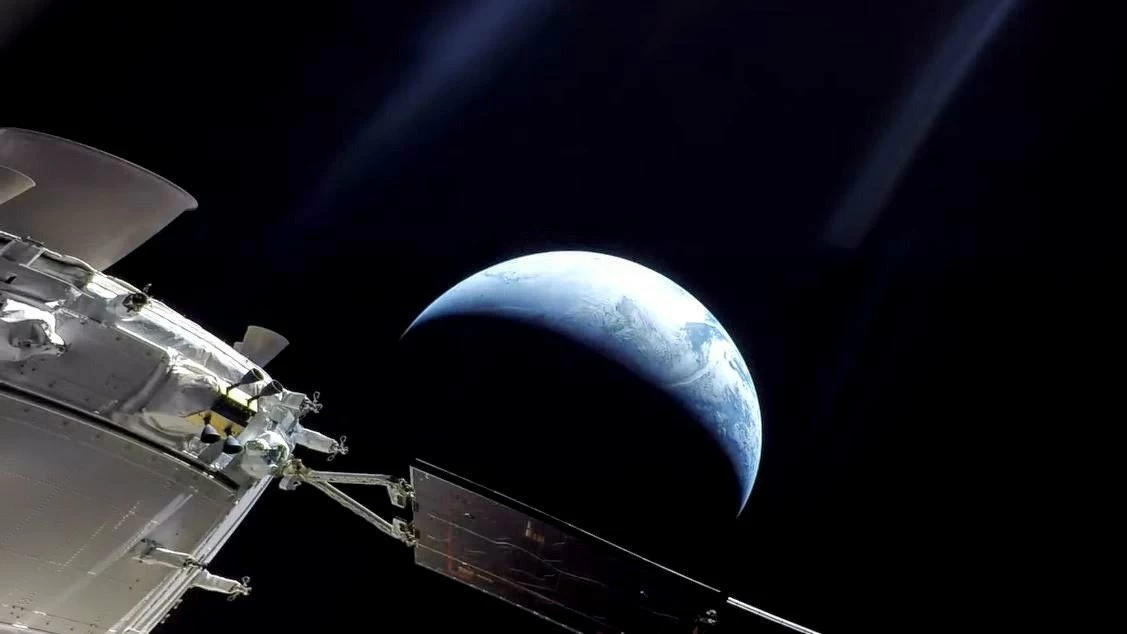
In a dramatic moment that recalled the inherent dangers of space, the crew of NASA's historic Artemis 2 mission was startled by an emergency alert indicating a "suspected leak in the capsule," just minutes after they crossed the "point of no return" on their way to the moon.
The mission launched on Wednesday, April 1, from Kennedy Space Center in Florida aboard the massive SLS rocket, representing the first human journey toward the moon in over 50 years, since the legendary Apollo missions of the 1970s. The crew consists of four astronauts: commander Reid Wiseman, pilot Victor Glover, astronaut Christina Koch, and Canadian astronaut Jeremy Hansen.
Details of the Incident
After the successful execution of the critical "burn" that propelled them out of Earth's orbit and toward the moon, the Orion capsule received a sudden emergency alert just 20 minutes after this burn, which is considered the "point of no return." In the crew's first live interview from space, Jeremy Hansen recounted the thrilling details, stating, "The message grabbed our attention intensely... Our thoughts suddenly shifted from heading to the moon to questioning: Should we abort the mission, put on our space suits, and plan to return to Earth in less than a day?".
A cabin leak is one of the most dangerous potential issues in space, as it can lead to a drop in pressure inside the capsule, threatening the structural integrity and exposing the crew to the deadly vacuum of space. Fortunately, a quick examination by the crew and the monitoring team at the control center in Houston revealed that the message was merely a technical glitch, and that the cabin pressure was completely normal and unaffected.
Background & Context
The Artemis 2 mission is part of the ambitious Artemis program aimed at returning humans to the moon, and eventually to Mars in the future. This mission represents a critical test for the Orion capsule and life support systems in deep space conditions, with the total mission distance being approximately 685,000 miles (1.1 million kilometers).
On its sixth day of the journey, the spacecraft will surpass the record distance of the Apollo 13 mission, reaching its farthest point from Earth at an altitude of nearly 6,400 miles (over 10,000 kilometers) above the moon's surface. After orbiting the moon, the capsule will return to Earth in a journey lasting about four days.
Impact & Consequences
Despite the terrifying moment, the crew and ground team confirmed that the mission is proceeding well, and that such false alarms are a normal part of testing technology under unprecedented harsh conditions. The crew also dealt with excess cabin cooling, which was resolved by adjusting fan speeds in collaboration with ground control.
The crew shared amusing details about their daily lives in space, such as one of them sleeping under the control screens, and Christina Koch sleeping "upside down" like a bat in the middle of the capsule. These moments reflect the team spirit and adaptability to the unusual conditions in space.
Regional Significance
The Artemis 2 mission is a significant step in the field of space exploration and may inspire Arab countries to enhance their investments in space science and technology. With the growing Arab interest in space programs, this mission could help stimulate cooperation among Arab nations in this field.
In conclusion, the Artemis 2 mission embodies humanity's aspirations for space exploration and opens new horizons for future travel to the moon and Mars, reflecting the importance of scientific research and technology in achieving great accomplishments.