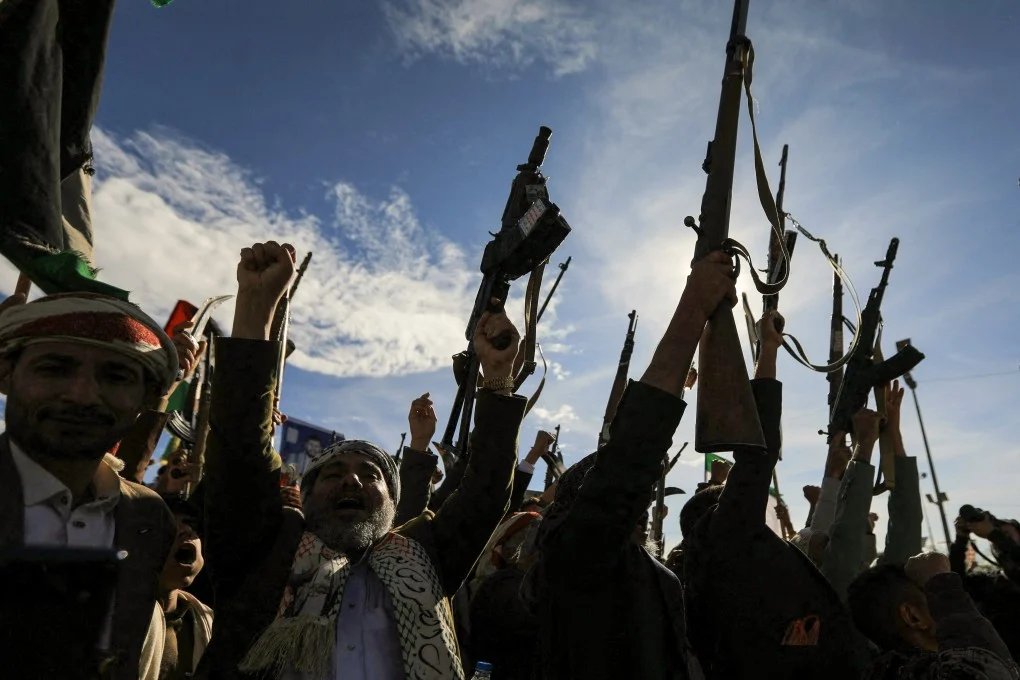
The U.S.-Israeli war against Iran has entered its second month, with increasing risks to vital maritime shipping routes. In a new development, Iranian-backed Houthis launched missiles at Israel from Yemeni territory, escalating tensions in the region. Reports indicate that the Israeli army managed to intercept one of these missiles, reflecting the growing security challenges faced by Israel.
This escalation comes at a critical time, as analyses suggest that the likelihood of the conflict continuing for an extended period may be slim, according to Chinese analysts. They pointed out that the current situation could lead to the closure of important shipping routes, impacting global trade.
Details of the Incident
On Saturday, the Houthis announced that they launched the missiles as a warning to Israel, a move that reflects their support for Iran in the face of U.S. and Israeli pressures. These attacks are part of the Houthis' strategy to strengthen their position in the regional conflict, as they seek to demonstrate their power and ability to influence events in the area.
The Israeli army, for its part, confirmed that it intercepted one of the missiles, indicating their readiness to confront any threats. This escalation occurs at a sensitive time, as the United States and Israel seek to bolster their alliances in the region to counter Iran's growing influence.
Background & Context
Historically, relations between Iran and Israel have been tense, with Israel viewing Iran as an existential threat. For years, Iran has faced international pressure due to its nuclear program and support for armed groups in the region. In response, the United States has sought to diminish Iran's influence in the Middle East, leading to heightened tensions between the two parties.
The U.S.-Israeli alliance against Iran is not new, but it has seen a notable escalation in recent months, especially following attacks targeting Iranian nuclear facilities. This escalation in the conflict reflects the increasing geopolitical tensions in the region, as each side strives to achieve its strategic objectives.
Impact & Consequences
The potential consequences of this escalation are manifold, as it may lead to increased tensions in the region and affect regional stability. The closure of maritime shipping routes could result in rising oil and commodity prices, impacting the global economy.
Furthermore, this escalation may exacerbate the humanitarian situation in Yemen, where the Yemeni people are suffering from a severe humanitarian crisis. The Houthis, who receive support from Iran, may exploit this situation to strengthen their position domestically, complicating the conflict further.
Regional Significance
For the Arab region, the rising tensions between Iran and Israel could impact stability in countries like Lebanon, Syria, and Iraq. These countries are already suffering from internal conflicts, and any further escalation could worsen humanitarian and political conditions.
Arab countries seeking to improve relations with Iran may find themselves in a difficult position, as pressure from the United States and Israel to counter Iranian influence increases. In this context, it becomes essential for Arab nations to adopt balanced policies to safeguard their national interests.
In conclusion, the situation in the region remains tense, with the U.S.-Israeli war on Iran continuing and tensions escalating with the Houthis. The current situation requires careful analysis and international cooperation to maintain security and stability in the region.