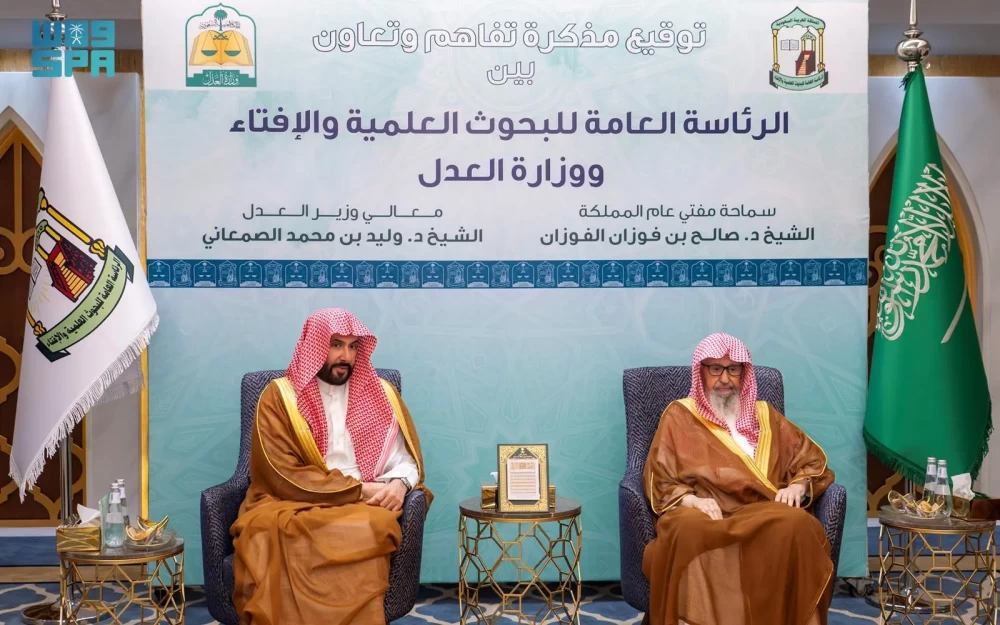
The Ministry of Justice in the Kingdom of Saudi Arabia has signed a memorandum of understanding with the General Presidency for Scientific Research and Ifta, aimed at studying mechanisms for handling, addressing, and documenting divorce cases. This step is part of efforts to enhance integration between the two entities and improve the efficiency of procedures related to family issues.
The memorandum is based on specialized legislations, foremost among them the Personal Status Law, which outlines comprehensive provisions for organizing family matters. This law contributes to standardizing processing and documentation procedures, facilitating the journey for beneficiaries while reducing timeframes, and ensuring accuracy in procedures that affect the stability of families and society.
Event Details
The Grand Mufti of the Kingdom, Sheikh Saleh Al-Fawzan, explained that Islamic law aims to achieve the interests of individuals and protect their rights. He noted that the cooperation between the General Presidency for Scientific Research and Ifta and the Ministry of Justice represents the fruit of joint efforts to regulate divorce cases and protect the family unit. This collaboration reflects the existence of robust systems such as the Personal Status Law, which contributes to reassuring the inquirer and ensuring the documentation of the rights of both spouses in accordance with the objectives of Sharia.
For his part, Minister of Justice Dr. Walid Al-Samaani affirmed that this memorandum represents an important step towards enhancing integration in handling and documenting divorce cases. He pointed out that this step ensures clarity and integration of procedures, elevating the quality of services provided and improving the experience of beneficiaries.
Background & Context
This memorandum comes at a time when the Kingdom is witnessing ongoing efforts to develop legal and social systems. The Personal Status Law approved by the Kingdom reflects its commitment to enhancing individual rights and protecting the family. These efforts align with the Kingdom's Vision 2030, which seeks to improve the quality of life and promote social justice.
The memorandum also includes the formation of a joint committee tasked with studying mechanisms for dealing with divorce cases and the legal procedures for addressing and documenting them. The committee will monitor existing cases during the transitional phase and address any procedural or technical challenges that may arise, ensuring the continuity of quality service provided.
Impact & Consequences
This memorandum contributes to enhancing integration among the concerned parties, supporting the development of procedures related to family issues. It also raises the efficiency of the outcomes of these procedures, positively reflecting on the beneficiaries' experience. This step is expected to lead to the realization of prompt justice and enhance the stability of the legal status of families.
Improving divorce procedures and their documentation reflects the Kingdom's commitment to protecting individual rights and enhancing community stability. Additionally, these initiatives contribute to reducing family disputes and improving relationships among individuals, positively impacting the social fabric.
Regional Significance
This step serves as a model for the Arab region, where many countries face similar challenges in addressing family issues. Strengthening cooperation among government entities in the Kingdom can encourage other countries to take similar steps to improve their legal and social systems.
In conclusion, this understanding between the Ministry of Justice and the General Presidency for Scientific Research and Ifta represents an important step towards achieving family justice and reflects the Kingdom's commitment to improving the lives of its citizens and enhancing their rights.